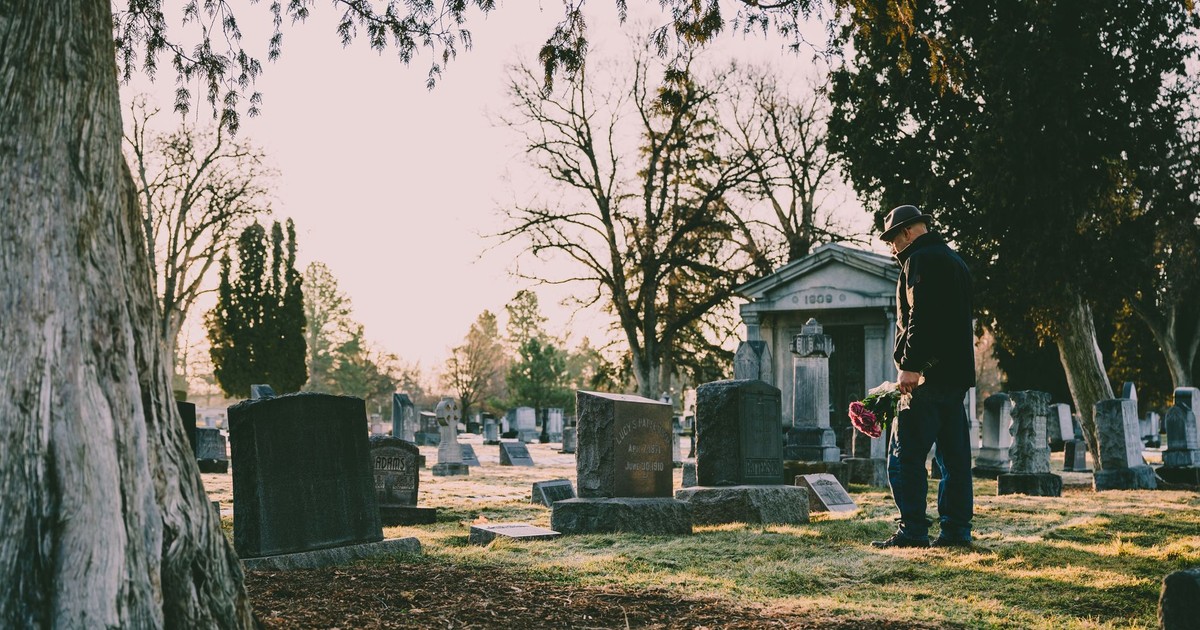

Your father hasn’t spoken to his mother in years. He refused to drive the two hours to see her when she was sick. He had his reasons, or at least a version of them, and you’ve heard those reasons so many times they’ve worn grooves in your memory. Then she dies, and somehow, impossibly, he is standing at the front of the funeral home in a dark jacket, accepting condolences, his name read aloud in the obituary as her beloved son.
Estrangement followed by death creates a particular kind of disorientation: the person who absented themselves from a life now claims a place in the ceremony of its ending. You are holding a paper program with a photo of a woman you loved, trying to figure out what you are supposed to feel. Grief, yes. Anger, also yes. Something that doesn’t have a clean name yet, something closer to bewilderment.
This is the story a lot of families know and almost none of them say out loud. The estrangement that existed in life, and the strange reset button that a death seems to press for everyone who caused it.
The Numbers Behind What You’re Experiencing
You are not in a fringe situation. A 2024 Harris Poll surveyed 1,068 US adults and found that 35 percent reported being estranged from an immediate family member such as a parent or a sibling. That is more than one in three people. If you are sitting in a pew at a funeral, roughly a third of the people around you are carrying some version of the same math.
Researchers have found that pathways to estrangement often connect back to early experiences with harsh parenting, parental favoritism, and parental divorce, while other common triggers include tensions with in-laws, disputes over money and inheritances, and value differences. It almost never starts with one dramatic rupture. It builds, quietly, over years of small grievances that never got resolved, until one day someone says “I’m done” and means it.
Cornell sociologist Karl Pillemer describes how long-simmering feuds can culminate in a “volcanic event” in which one family member declares they are finished. The resulting estrangement functions as a form of chronic stress, rooted in broken attachment bonds and the persistent pain of social rejection. What the research does not address quite so directly is what happens when death arrives and the estranged family member suddenly decides they are ready to participate again.
Why Funerals Become the Reunion Nobody Planned
Funerals bring a cluster of decisions all at once: who speaks, whether there is a viewing, what religious language is used, and what happens after the service. Add to that mix a family member who spent years refusing to engage and has now materialized to grieve publicly, and you have a situation that is genuinely, specifically infuriating.
Funerals carry social permission that ordinary life does not. Attendance is low-cost and publicly legible as love. It requires no accountability for what came before. A parent who couldn’t make time during a terminal illness can arrive the morning of the service and, from the outside, look indistinguishable from someone who was present for every hard conversation. The optics reset in a way that years of absence do not.
For the people who were actually there (who drove the two hours, who sat in the hospital waiting room, who managed the phone calls with the hospice nurse) watching that happen is its own kind of loss. Not just because it feels unjust, though it does. But because the funeral is supposed to be the place where grief is honest and public, and instead it becomes one more performance of a family story that was never really true.
Many people in your position have also quietly wondered about the dynamics of a toxic family member and how those patterns echo through every major family event, including the ones that are supposed to be about someone else entirely.
The Obituary Name Problem
An obituary is a document, and a document has weight and permanence and the appearance of truth. When an estranged parent or sibling is listed as a loving family member, it creates a record that does not match reality, and that record will exist long after the funeral flowers have been thrown away.
This is not a small thing. It is the family story being edited one more time, and you don’t get to correct the draft. The language of obituaries is almost always soft and generous by convention, which means that the person who refused to visit a dying grandmother gets the same soft nouns as the person who bathed her every week. “Son.” “Brother.” “Beloved.” The words don’t discriminate, and they don’t footnote.
Estrangement, when family members are emotionally or physically distant due to unresolved conflict or trauma, can make funerals a source of profound anxiety, tension, and renewed pain rather than comfort. The grief you are managing at a family estrangement funeral is not only for the person who died. It is for the relationship they had with someone who couldn’t give them what they deserved while they were still alive. You are grieving double, and nobody is handing you a program that acknowledges that.
What the Person Who Stayed Away Often Does Not Understand
Your father, or your uncle, or whoever occupies the role in your family’s version of this story, may genuinely believe that arriving at the funeral is an act of courage. That he is doing something hard. That grief is grief, and that the years of silence are a separate matter from this moment of public mourning.
He is not entirely wrong that grief is complicated. What he is missing is the context that makes his presence feel so dissonant to everyone else in the room. Grief, when it has been absent from someone’s life for years, doesn’t get to land at the funeral and demand to be treated as equivalent to the grief of the people who were present. This is not a rule that gets written anywhere. It is simply something the people who were there know, without having to discuss it.
Pillemer’s research found that people who are estranged from a family member often feel deep sadness, long for reconnection, and wish they could turn back the clock and act differently to prevent the rift. That longing is real. It doesn’t cancel what happened, but it is real, and it helps to know that the person at the front of the room may be carrying something genuinely heavy, even if they made choices that put them there.
That does not mean you are required to comfort them. Those are two different things.
The Inheritance of the Unspoken
The children and grandchildren of estranged people absorb the weight of something they didn’t cause. You spent years managing questions about why grandma and your dad didn’t talk. You developed a talent for changing the subject at holidays. You learned to hold the grief of a relationship that could have existed but didn’t, and now you are being asked to hold a funeral that pretends it did.
Pillemer’s research found that unresolved rifts often create chronic stress for all family members involved, with evidence suggesting this stress can lead to depression and anxiety, and even physical health problems. Rifts frequently involve what he calls “collateral damage,” when family members who are not involved in the original argument get pulled into the rift and cut off from loved ones. The collateral damage doesn’t stop when someone dies. In some ways, it intensifies, because now there’s no possibility of resolution, only the accounting of what was left undone.
You carry the weight of your grandmother’s sadness about the estrangement, the particular sorrow of a parent whose child stopped coming. You carry your own grief about what she deserved and didn’t receive. And now you are also carrying the performance of a reconciliation that came twenty-four hours too late to matter.
What You Are Actually Allowed to Feel
The answer, in full, is everything. You are allowed to grieve your grandmother deeply and be furious at the person who arrived only for the service, too late to matter. You are allowed to find the whole scene almost darkly absurd, to notice the irony of the handshakes and the condolences, and to also cry through the whole service because you loved her and she is gone. None of those things cancel each other out.
What you are not required to do is perform a version of this day that pretends the history doesn’t exist. You don’t have to stand next to someone at the reception as though the years of absence were a minor inconvenience. You don’t owe anyone a neat family portrait. Grief has enough weight without also requiring you to carry the fiction.
The people who understand what actually happened will know what the presence at the funeral means. The people who don’t understand it are probably not paying close attention to you anyway.
What Stays
Funerals end. The folding chairs get put away, the casserole dishes get returned, and everyone goes back to whatever version of the family they came from. The person who came only for the service will return to the same life that kept them away, and you will return to yours.
What stays is the thing that was true before the service started: you were there, and they weren’t, and no amount of dark-jacket grief can rewrite that accounting. The obituary will say what it says. The funeral will have happened the way it happened. But the people who drove the two hours, who held her hand, who answered the phone at 11pm when the nurses called, those people know what love actually looked like in practice, and so did she.
Family estrangement and funeral ritual collide in the most disorienting way because one is about severing and one is supposed to be about honoring. When they meet, there is no clean ceremony for what actually happened. The service proceeds, the names are read, and you sit with the gap between what was said and what you know.
Some of these ruptures go back further than the people involved in them. The estrangement between your father and his mother almost certainly has roots in something that happened before you were born, a pattern that was already in motion when he was small. That doesn’t excuse the years of absence, and it doesn’t make the funeral any easier to sit through. But it does mean that what you watched play out in that room was not really about one day. It was the last scene of a very long story that nobody in it ever quite managed to tell honestly while they still had time.
Disclaimer: This information is not intended to be a substitute for professional medical advice, diagnosis, or treatment and is for information only. Always seek the advice of your physician or another qualified health provider with any questions about your medical condition and/or current medication. Do not disregard professional medical advice or delay seeking advice or treatment because of something you have read here.
AI Disclaimer: This article was created with the assistance of AI tools and reviewed by a human editor.