

A faith crisis rarely announces itself with drama. There’s no single moment where you sit down, cross your arms, and decide you’re done. More often, it moves through a person the way water moves through limestone – slowly, invisibly, reshaping things from the inside before anyone on the outside notices anything has changed. You keep attending services. You keep saying the prayers in the right order. You keep smiling at the people you’ve known for twenty years.
About 35% of Americans have left the religion of their childhood, according to a December 2025 study from the Pew Research Center. But that number only captures the people who eventually changed their label. It says nothing about the much larger group navigating something harder to name – the people still inside the building, still on the membership roll, still leading the Bible study, while privately wondering whether any of it is still true for them.
That in-between place is what a silent faith crisis actually is. Not a dramatic exit. Not an angry deconstruction posted to social media. Just a slow, private renegotiation that often goes unaddressed for years because the person experiencing it doesn’t have language for it, and the institution around them rarely creates space for it. Here are twelve signs that it might already be happening.
1. Services Feel Like a Script You’ve Memorized

There’s a difference between familiarity and going through the motions, and the line between them can be hard to identify until you’ve already crossed it. Familiarity feels like coming home – the liturgy or worship set is comfortable, and that comfort deepens your engagement. Going through the motions feels like reciting a phone number you’ve had so long it holds no meaning: the words come out perfectly, but they originate nowhere.
When every service feels choreographed rather than felt – when you know precisely when to stand, when to say “amen,” when to look moved – that automation can signal that something has shifted in your relationship to the content. You’re performing the form without experiencing whatever the form was designed to point toward. This isn’t a moral failure. It’s often the first visible sign that a deeper process is underway, one that deserves honest attention rather than more determined performance.
2. Prayer Has Become a Monologue You Don’t Believe Anyone Is Hearing
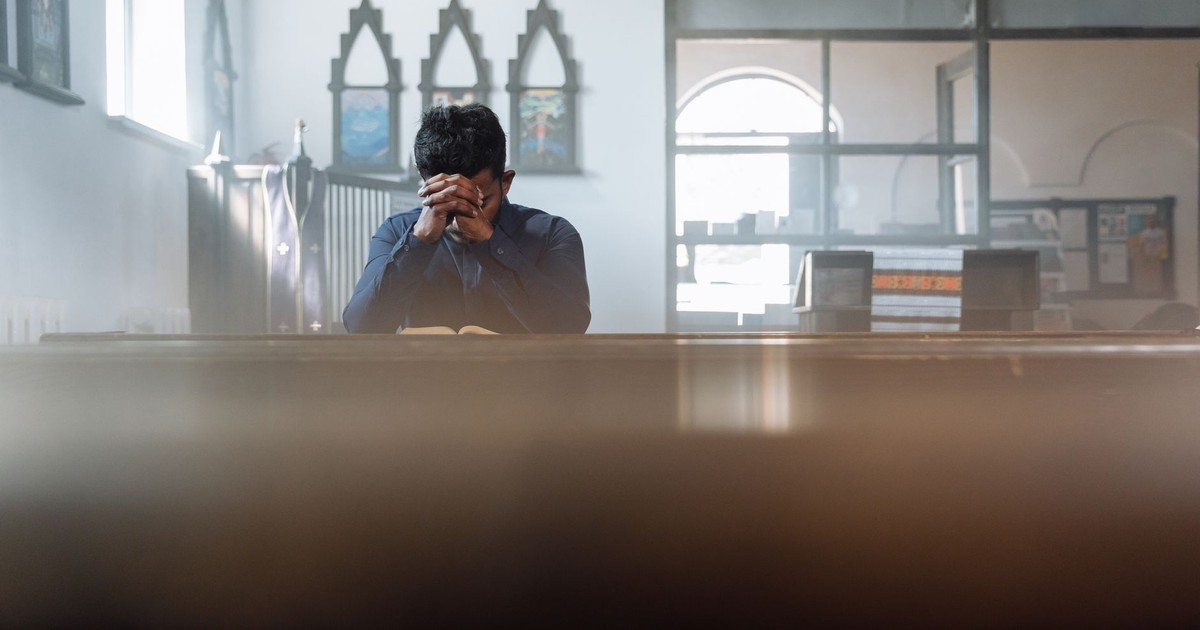
Prayer, across nearly every tradition that practices it, is framed as relational – a conversation rather than a dispatch. When it starts to feel like sending a letter to an address you’re no longer sure exists, that’s worth noticing. Many people in a silent faith crisis keep praying out of habit, out of obligation, or out of fear of what it would mean to stop. But the quality of the prayer changes. It becomes careful, edited, performative – especially when it’s prayed aloud with others.
The private version is often more revealing. If you catch yourself not praying alone at all anymore, or if your private prayers feel like going through a routine you no longer believe in, that absence of genuine communication points toward something deeper than busyness or distraction. It points toward doubt about whether there’s anyone on the other end.
3. Doubt Feels Dangerous Rather Than Normal

Doubt has always been part of religious life – theologians, mystics, and clergy across centuries have written about it extensively. But many contemporary congregations treat it as something to be quickly resolved, gently redirected, or quietly discouraged. When a person in the pew absorbs that message, doubt stops being a question they can bring to their community and starts being a secret they have to protect.
Among religiously unaffiliated Americans, 64% cited questioning religious teachings as an extremely or very important reason for their nonaffiliation, and 54% said they don’t need religion to be spiritual. What those numbers don’t capture is how many people reached those conclusions years before they changed their religious label – sitting in services, smiling, saying nothing. When doubt can’t be spoken out loud, it doesn’t disappear. It just goes underground and grows in the dark.
4. You’ve Started Editing Yourself Around Church People

Pay attention to who you relax around and who you perform for. If the people in your congregation have become an audience rather than a community – if you find yourself carefully managing what you say, what you post, what questions you ask, what books you mention reading – that maintenance of a persona is exhausting in a way that has its own texture. It’s not the same as normal social awareness. It’s closer to the feeling of being undercover.
This kind of self-editing often starts small: you don’t mention the podcast you’ve been listening to, or you leave out the part of the story where you had serious doubts. But it tends to spread. Eventually you might find that the people who know you best inside the church are actually among the people who know you least – because what they know is the version of you that you’ve decided is acceptable in that space.
5. Institutional Scandal Has Broken Something That Hasn’t Healed
When a religious institution’s leaders are involved in abuse, cover-up, or hypocrisy, the injury isn’t only moral outrage – it’s often a structural injury to the faith itself. If what you believed was partly contingent on trusting the people who embodied and transmitted it, their failure creates a question that is hard to answer: can the belief system survive the exposure of the people who carried it?
Among former Catholics, 39% cited clergy and religious leader scandals as a very or extremely important reason for leaving. But again, that figure only counts the people who left. Many who stayed are carrying the same injury without any formal acknowledgment that it happened, still sitting in the same pews, still writing the same checks, still listening to the same institutional voice – now with a fracture underneath that nobody is addressing.
6. Religious Teachings on Social Issues Have Started to Feel Indefensible

This one is delicate because it’s easy to frame it as politics bleeding into faith. But for many people in a silent faith crisis, it’s not that politics has changed their faith – it’s that they’ve noticed a growing gap between what their tradition teaches about certain groups of people and what they believe about the dignity of those people. That gap is its own kind of theological crisis.
Dissatisfaction with church teachings on social and political issues was cited by 37% of former Catholics as a very or extremely important reason for leaving. For people who haven’t left yet, that dissatisfaction often emerges as a learned ability to compartmentalize – sitting through a sermon that contradicts something they believe deeply, then telling themselves it doesn’t matter, then going home and not thinking about it. Compartmentalization works for a while. It does not work indefinitely.
7. You’ve Stopped Bringing Your Real Life to Your Faith Community

Some church participation is entirely public-facing: you attend the services, you contribute to the potlucks, you serve on the committee. And then there’s the kind where you actually bring your life – the marriage that’s struggling, the child you’re worried about, the diagnosis you just received, the question that won’t go away. When those two things completely separate, when the community becomes a place you perform rather than a place you’re known, something foundational has changed.
This disconnection can happen for many reasons. Sometimes the community hasn’t created space for honesty. Sometimes the person has had a bad experience of being vulnerable and getting a response that made things worse. And sometimes the disconnection is a symptom of the faith crisis itself – you’ve stopped bringing your real life to the community because you’ve stopped believing the community’s framework can hold it. Either way, a congregation full of people who aren’t actually sharing their lives is doing something, but it probably isn’t community.
8. Spiritual Practices That Once Felt Meaningful Now Feel Empty
Across traditions, religious practice is understood to be sustaining – the ritual itself carries something, connects a person to something larger than the immediate moment. When that experience drains away and the practice is left feeling hollow, it’s one of the more disorienting signs of a silent faith crisis, precisely because it can look identical from the outside to genuine engagement.
Barna’s analysis of data from 2000 to 2025 found that several core indicators of Christian conviction – including the importance of religious faith, Christian identity, monthly church attendance, and evangelism efforts – have weakened. That weakening doesn’t register immediately in attendance numbers or membership rolls. It surfaces first in the interior experience of the people still in the seats – the feeling that the prayers, the songs, and the sacraments are beautiful containers that no longer hold anything for them personally.
9. You’ve Found Yourself Envying People Who Don’t Have to Think About Any of This

There’s a particular kind of weariness that comes from carrying a set of beliefs that require constant defending, internally and externally – from the cognitive effort of reconciling doubt with doctrine, from the social labor of maintaining a faith identity in a community where questioning is unwelcome. At a certain point, some people start quietly envying those who simply aren’t tangled up in it.
That envy isn’t a theological argument. But it is information. It often signals that faith has become more of a burden than a source of meaning – which, by almost any tradition’s own account, is not what it was designed to be. According to the December 2025 Pew Research Center report on religious switching, 46% of people who left their childhood religion cited stopping belief in its teachings as the main reason, while another 38% said religion simply was not important in their lives or that they had gradually drifted away. For many people, both of those processes began not with a decisive turn but with a quiet exhaustion.
10. You’re Going Through a Significant Life Event Without Turning to Your Faith

The big moments tend to be revealing. A diagnosis, a pregnancy loss, a relationship ending, a death in the family – these are the occasions when people discover what they actually reach for. If you’ve been through something significant in the last few years and noticed that your faith was not the first thing you reached for, or that you reached for it and found it gave you nothing, that gap deserves honest attention.
This isn’t about whether you “should” have found comfort in your faith – that framing puts the pressure in the wrong place. It’s about what actually happened. Some people discover in grief that their belief goes much deeper than they realized. Others discover the opposite: that what they thought was a living relationship with the divine was actually a habit that functioned adequately in calm conditions and fell apart under real weight.
11. You Feel a Complicated Relief When You Skip a Service
Missing a service used to create a specific kind of guilt – or at least a sense that something was absent. Now skipping it brings something closer to relief. The shoulders drop. The day opens up. There’s a freedom in it that you then feel vaguely ashamed of. That combination – relief followed by guilt followed by confusion about why you feel both – is one of the more honest markers of a silent faith crisis.
Data from 2023 to 2024 found that only 30% of women and 26% of men between the ages of 18 and 24 report praying daily, compared to 54% of women and 40% of men in the same age group in 2007. That isn’t just a cultural trend – behind each of those data points is a person who used to do something and gradually stopped, often without ever formally deciding to stop. The relief you feel when you skip isn’t a character flaw. It’s a signal that something about your relationship to the institution, the practice, or the belief has changed and hasn’t been named yet.
12. You’ve Never Said Any of This Out Loud to Anyone

The previous eleven signs can exist in someone who has a community to process them with. But when none of it has been said out loud – when you’ve been carrying the doubt, the emptiness, the relief, the grief, the compartmentalization for months or years without once naming it to another person – the silence itself becomes the crisis.
Americans who leave their childhood religion typically do so by the age of 30. What that timeline often reflects is the accumulation of years of private renegotiation that nobody around the person knew was happening. Not because no one would have listened, but because the person couldn’t find the words, or didn’t feel safe using them, or wasn’t sure whether what they were experiencing was real enough to name. The silence doesn’t protect the faith. It just makes whatever is happening harder to examine honestly.
Where to Go From Here

What most people in this situation need before anything else is simply the ability to say what’s actually true. Not to a theologian with answers, not to a pastor with an investment in a particular outcome, but to someone who can listen without a stake in the result. That might be a therapist, a trusted friend, a spiritual director outside your own community, or simply a journal that you actually write in honestly rather than performing for an imagined reader. The internal conversation – the one where you stop editing and say what you actually think – almost always has to start somewhere before it can go anywhere.
Some people who recognize themselves in this list will eventually leave their tradition. Some will stay and find the crisis resolves into something deeper and more honest than what they had before. Some will hold the question open for years without arriving anywhere that feels like resolution. The one thing that rarely helps is continuing to perform certainty you don’t have, in rooms full of people who are probably doing the same thing.
Disclaimer: This information is not intended to be a substitute for professional medical advice, diagnosis, or treatment and is for information only. Always seek the advice of your physician or another qualified health provider with any questions about your medical condition and/or current medication. Do not disregard professional medical advice or delay seeking advice or treatment because of something you have read here.
AI Disclaimer: This article was created with the assistance of AI tools and reviewed by a human editor.