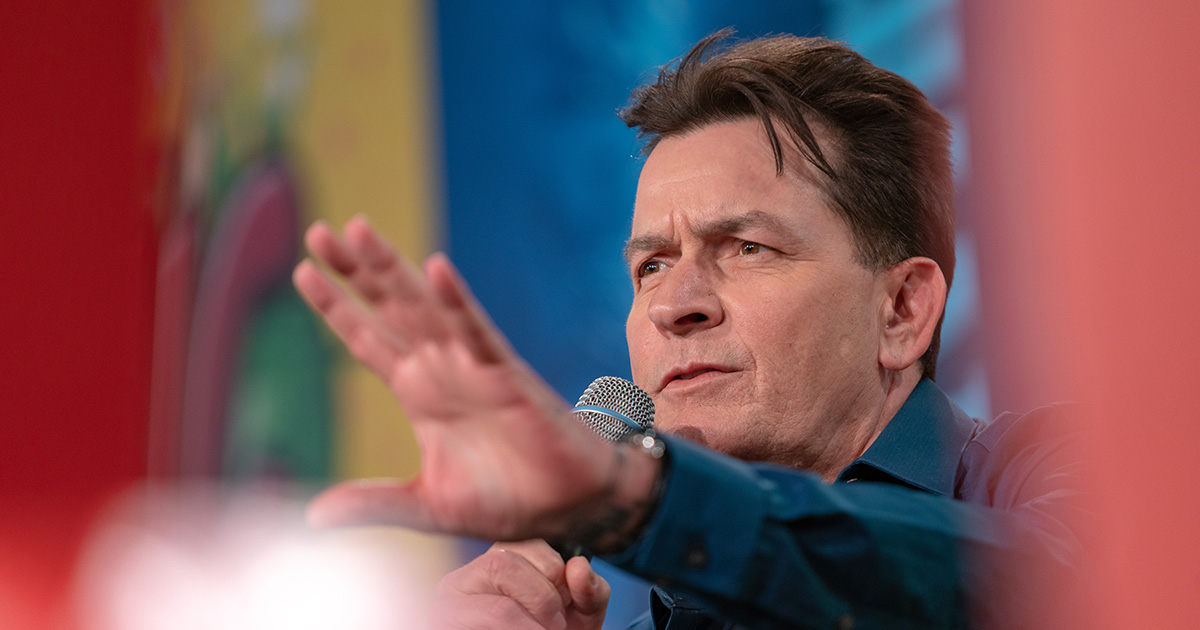

Charlie Sheen has never been easy to interview, and he apparently hasn’t gotten easier with age. In a conversation with The Hollywood Reporter released in June 2026, the 60-year-old sat down to discuss his Netflix documentary aka Charlie Sheen and came prepared to talk on his own terms. When the journalist ventured into territory he considered off-limits, Sheen made that known with the kind of bluntness that has always been his signature, whether the world found it charming or not.
Asked for an update on his health, he told the outlet, “I think my presence answers those questions.” It’s a line that does a lot of work in very few words. It signals irritation. It draws a boundary. And it leaves the journalist with exactly as much information as Sheen decided they deserved.
When the conversation shifted to his financial state, he fired back: “Would you ask me that question at a dinner party in front of my parents? I’m fine.” There is something almost funny about invoking the dinner party standard in a formal media interview, but the deflection also contains a real feeling: a man who has watched his most private crises become public entertainment for decades.
The Questions Were Fair, Even If He Didn’t Want to Answer Them

Both Charlie Sheen’s health and Charlie Sheen’s finances have been subjects of genuine public concern for years. Not idle gossip, but documented, consequential, on-the-record events that he himself put into the public record.
In 2015, Sheen publicly revealed that he had been diagnosed with HIV roughly four years earlier, after going to the hospital for headaches and night sweats. The announcement came on NBC’s Today show, in an interview that was both extraordinary and devastating to watch. He told his doctor beside him, he told the world, and in doing so he made his health status a matter of public conversation in a way that a single terse line about his “presence” cannot simply close.
Sheen acknowledged on the Today show that he had paid upward of $10 million to keep his diagnosis secret. Money spent not on living, not on investment, but on damage control for a secret that eventually came out anyway. In his 2025 memoir, The Book of Sheen, Sheen recalled feeling relief after being diagnosed with HIV in 2011. His memoir went deep into the experience, into the treatment, into what came before and after. That level of personal openness invites follow-up questions.
How $150 Million Became $1 Million
Sheen is worth an estimated $1 million today, but was once worth $150 million, according to Celebrity Net Worth. He rose to fame in the 1980s after starring in films including Wall Street and Platoon, and later became one of the highest-paid actors on television at the height of his career.
In 2003, Sheen landed the starring role in Two and a Half Men, which made him the highest-paid male actor on television, reportedly earning him $1.8 million per episode during its eighth season, according to the Associated Press. Not annually. Per episode. The kind of money that should, by most calculations, be impossible to fully exhaust.
Sheen’s financial struggles can be attributed to multiple divorces, child support payments, lawsuits, extortion attempts, sports betting, and a well-documented history of alcohol and drug addiction. Each item on that list sounds manageable on its own. Together, over decades, they became a fortune-ending avalanche.
The child support numbers alone were staggering during their peak years. Courts ordered Sheen to pay $55,000 a month to ex-wife Brooke Mueller and $20,000 a month to ex-wife Denise Richards, with both women also receiving 9.5 percent of his gross annual income from all sources in excess of $2.1 million. That’s not a rough month. That’s a structural drain that runs regardless of whether the work keeps coming in.
The extortion dimension added another layer. During the years between his HIV diagnosis and his public disclosure, Sheen paid considerable sums to people who threatened to expose his status. By the time he went public on the Today show in 2015, he acknowledged he had paid upward of $10 million to keep his diagnosis secret.
In 2006, Sheen paid $7.6 million for a Beverly Hills mansion that later went into foreclosure in 2019. He tried to sell the home in 2018 for $10 million, lowered the price the following year to nearly $8 million, and eventually sold it for $6.6 million in January 2020. Even the assets didn’t hold.
Sheen spoke to Graham Besinger about scaling back his spending in November 2025, after decades of living as large as possible. “I would take a step back and it’s like let’s get out of the want and let’s just settle in to ‘this is what I need,'” he said. “It’s not an impossible adjustment, but, it’s not always the smoothest one either.” Read that in the context of where he started and where he ended up, and the adjustment he’s describing comes into sharp focus. It’s not a billionaire choosing a smaller yacht.
The Documentary, the Memoir, and the Version He’s Choosing Now

All of this came to a head in September 2025, when Sheen released two major projects at once. The Two and a Half Men star sat down with The Hollywood Reporter to discuss his Netflix documentary, aka Charlie Sheen, which was released on Netflix on September 10, 2025, as a “love letter” to his father, Martin Sheen. The memoir, The Book of Sheen, dropped the day before.
The book chronicles Sheen’s life from a near-death experience during his birth in 1965 to the moment he decided to get sober in 2017, and carries a unique writing style with certain words purposefully misspelled and written the way Sheen sees them in his mind. “Dude,” for instance, became “dood.” Sheen said he was inspired by the narration and rhythm in Apocalypse Now, the 1979 film his father starred in.
A memoir is a controlled environment. An interview is not.
The sobriety chapter is where Sheen seems most at ease, and most genuinely proud. According to ABC News, he said fatherhood quickly occupied his life when he got sober eight years ago: once he “finally put down the bottle,” his children started coming to his home. That detail, quietly devastating in its precision, says more about what the drinking cost him than any financial figure could.
He’s also been candid about the lifestyle changes sobriety required. When asked about returning to old habits, he described a clear-eyed accounting of the math: “I’m not connected to the people of the past … if I were to go back to those choices to numb myself, get out of my head, or feel differently, I have so much evidence that it’s only going to make things worse.”
What the Icy Answers Are Actually Saying

One reading of Charlie Sheen’s blunt deflections in that June 2026 interview is arrogance. The other reading is harder to dismiss.
The man has been diagnosed with HIV, declared public enemy number one by a network, lost a fortune, lost marriages, lost custody arrangements, and watched all of it dissected in real time by an industry that profited enormously from the spectacle. He has written a memoir. He has made a documentary. He has spoken to ABC News, Fox News Digital, People magazine, the New York Post, and Graham Besinger. He has answered a great many questions.
When a journalist in June 2026 asks him about his health and his finances, Sheen’s response isn’t really stonewalling. It’s rationing. “I think my presence answers those questions” is the answer of a man who has given the same answer many different ways and decided this time he wasn’t going to give it again.
The Ongoing Question Nobody Can Fully Answer

Charlie Sheen’s health and finances in 2026 remain murky, by design. His HIV status is managed. His net worth, as estimated by outside observers, sits at roughly $1 million, a number he has pointedly declined to confirm or discuss. Whether that figure captures the whole story, no one outside his accountant and doctor can say.
Sheen has spent the past two years engaged in the most sustained, deliberate image recalibration of his career: the memoir, the documentary, the press tour, the sobriety milestone. He is deciding what story gets told. He is deciding who gets access to which parts of it.
The dinner party line was not really about dinner parties. It was about the fact that some questions feel indistinguishable from excavation, and after sixty years of having every crisis turned into content, Charlie Sheen has earned the right to decide which shovel he’ll hand over. Whether or not a reporter agrees with that decision is, as he’d probably point out, beside the point. He already told you he’s fine.
Disclaimer: This information is not intended to be a substitute for professional medical advice, diagnosis, or treatment and is for information only. Always seek the advice of your physician or another qualified health provider with any questions about your medical condition and/or current medication. Do not disregard professional medical advice or delay seeking advice or treatment because of something you have read here.
AI Disclaimer: This article was created with the assistance of AI tools and reviewed by a human editor.