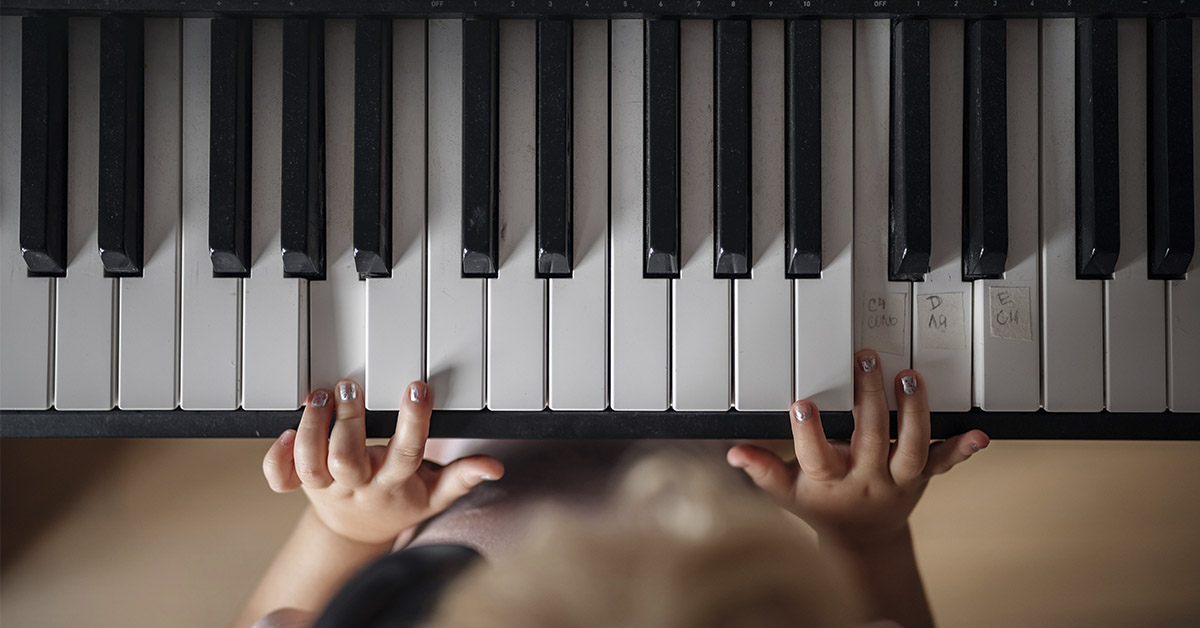

A piano prodigy, Miss A, a name her parents chose to keep their daughter’s identity private, sat at a piano in a pink dress and a neat updo in March 2025, placed her hands on the keys, and played Beethoven’s Für Elise entirely from memory. She was 4 years old. When she finished, she moved straight into Robert Schumann’s Wild Horseman without a pause. Both pieces were part of her recorded submission to the World Open Online Music Competition. The judges gave her a Gold Award, the competition’s highest prize tier.
The performance video has since approached one million views. The Music Man, a UK-based publication covering classical music education and performance, first reported the story in detail in December 2025. Their writer described being swept up in the music and astonished that someone so young could play with that kind of expression, before turning to the question most viewers eventually arrive at. How does a child who hasn’t started school yet pull off something like this?
On the bench, Miss A barely reaches the pedals. But the sound she produces is controlled, clean, and carries feeling across both pieces. She doesn’t stumble through passages that regularly trip up teenage students. She plays them with intention.
Her piano teacher, Yoon Sen Lee, is a Perth-based educator with nearly four decades of experience. Lee holds a senior examiner role at the Australian Music Examinations Board and a faculty position at the University of Western Australia, and he has said that Miss A carries a deep passion for music and an ability to convey emotion through the instrument that goes well beyond what anyone would expect at her age. He noticed it from their earliest lessons together.
What Für Elise Actually Demands
Most people recognize the opening notes of Für Elise within a few seconds. The alternating E and D-sharp melody is one of the most familiar sounds in Western music. Right up there with the opening of Beethoven’s Fifth Symphony and the Ode to Joy from the Ninth. That familiarity makes people assume the piece is easy. Because the first few bars genuinely are, and because children have been playing them at recitals and in YouTube clips for years. The full composition is a different thing altogether.
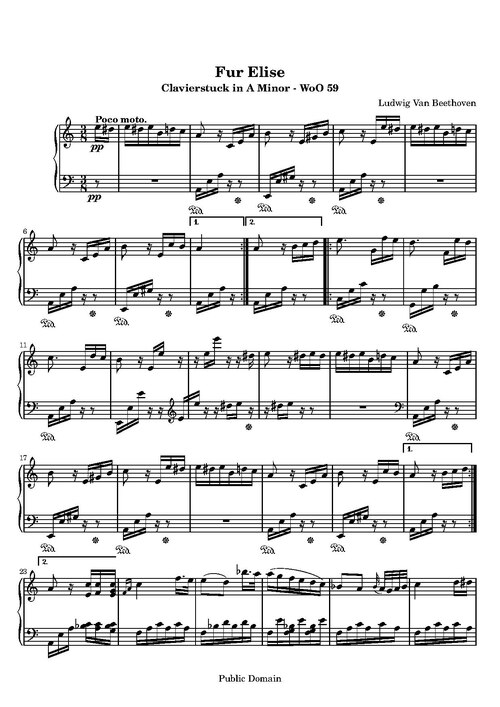
Beethoven wrote the bagatelle on April 27, 1810, and didn’t think much of it. A bagatelle is, by definition, a trifle, something short and lighthearted that isn’t meant to stand as a major work. So he set it aside. It sat untouched for the rest of his life, and no one published it until 1867, 40 years after his death. When the scholar Ludwig Nohl found the manuscript and transcribed it. No one knows where the original went after that. So every modern edition of Für Elise traces back to Nohl’s transcription alone.
Scholars have argued for over a century about whether the title is even correct. Nohl may have misread Beethoven’s notoriously bad handwriting, and Beethoven may have meant the dedication to read “Für Therese,” referring to Therese Malfatti. A student he reportedly proposed to around the time he wrote the piece. Other researchers have put forward the soprano Elisabeth Röckel and a young musician named Elise Barensfeld. But no one has settled the question. Because the original manuscript is gone, no one likely will.
Für Elise is a five-part rondo in A minor. Which means the main theme keeps coming back between contrasting episodes following the structure ABACA. The A section, the part everybody knows, is a flowing melody played over arpeggiated accompaniment. Where the left hand rolls through each chord one note at a time instead of striking the notes together. It sits comfortably under the fingers and doesn’t ask for much speed or power.
The B section shifts to F major and brings in 32nd-note runs. The fastest common note value most pianists deal with, and they require quick, even finger work and careful coordination between both hands. The C section goes further, dropping into D minor with a pedal-point bass. Where one low note repeats or sustains underneath everything else while the harmony moves above it. The bass carries diminished seventh chords. Which are dense and tense combinations of notes. Along with repeated-note passages, arpeggios, and a chromatic scale that moves up the keyboard one half step at a time without skipping a single key.
According to Piano Inspires, a publication of the Frances Clark Center for Keyboard Pedagogy, the Royal Conservatory of Music’s 2022 Piano Syllabus lists Für Elise as a Level 7 selection. Roughly as difficult as the easier Bach two-part inventions and other late-intermediate sonatinas. Level 7 falls around the midpoint of the RCM’s ten-level system. Most students don’t reach it before their early teens.
For a child of Miss A’s age, the physical demands alone are a lot. A young child’s hand span covers about half the reach of an adult pianist’s. So intervals that a teenager plays with a relaxed stretch force her to reposition constantly. The B and C sections also need sustained concentration and finger independence. Most children at that stage haven’t built the motor control to hold either one. Piano Inspires notes that one of the main challenges of Für Elise is picking a tempo that works for the fast sections without dragging in the lyrical passages.
That kind of thinking, holding the whole piece in mind and pacing the performance from start to finish. Is what separates a student who can play the notes from someone who can deliver the music. Miss A played all five sections. She played them as Beethoven wrote them.
The Competition Behind the Prize
That recorded performance went to the World Open Online Music Competition. Which accepts entrants from every country and covers everything from piano and violin to chamber ensembles and traditional instruments. The European Association of Music Educators and Performers organizes it in partnership with Producer Agency MIR Production, with support from ministries of culture and communications. The competition runs year-round across three seasonal editions, and Miss A entered the Spring 2025 edition.
Nobody performs on a stage. Each competitor records two compositions, preferably different in style, played from memory, and submits the video. The recording has to show both hands and the performer’s face clearly, and the audio cannot be edited. A panel of jury members then evaluates each submission, and every jury member teaches and performs on the instrument they are judging. Their decisions are final.
Scoring runs on a 100-point scale with fixed thresholds, and the competition places no cap on the number of prizes it gives out. Every entrant who hits a threshold receives the corresponding award. So the jury measures performers against the standard rather than against each other. A Gold Award, the top prize level, goes to anyone scoring between 90 and 100. Within that range, the competition breaks it down further. With 97 to 100 marking a Virtuoso. 93 to 96.99 an Outstanding Performer, and 90 to 92.99 an Excellent Performer. Silver covers 80 to 89, Bronze covers 70 to 79, and the judges give a Diploma for anything between 65 and 69.
Miss A submitted Für Elise alongside Schumann’s Wild Horseman. Schumann composed the Wild Horseman as part of a collection called the Album for the Young. A set of 43 short piano pieces written in 1848. The collection began as a birthday gift for his eldest daughter, Marie, and grew into a full work dedicated to his three daughters, Marie, Elise, and Julie. It sits at roughly a Grade 3 level. Below the Beethoven in technical demand. But it still calls for tight rhythmic control. A feeling of galloping forward motion, and the ability to shift between loud and soft with purpose rather than by accident. The Beethoven is slow and melancholy, and the Schumann is fast and playful. So the jury heard Miss A handle two very different kinds of music. The judges gave her the Gold.
The competition distributes $5,000 in prize money among selected top winners across all editions and disciplines and recognizes outstanding teachers with separate awards. For Miss A’s teacher, the recognition came on top of an already long record of international teaching distinctions.
The Teacher With 40 Years of Prodigies
Yoon Sen Lee grew up in Singapore, where he earned diplomas from the Royal Schools of Music, the Guildhall School of Music, and the Associated Board before moving to Australia in 1991. At the University of Western Australia, he finished a bachelor’s degree in piano performance with honors and a master’s with distinction. Won first prize at the Vose Concerto Competition. And performed with the West Australian Symphony Orchestra. A university scholarship then funded extended training in the Netherlands on the fortepiano, an early predecessor of the modern piano.
According to his school’s website, Lee’s teaching career now spans close to 40 years. He holds a senior examiner position and sits on the advisory board for the Australian Music Examinations Board in Western Australia. Teaches at the University of Western Australia and serves as a professor at the International Piano Academy in Imola, Italy.
He founded the Yoon Sen Lee Music School in Perth in 2006, and its students have gone on to the Juilliard School, the New England Conservatory, and leading institutions across Europe and Australia. They have earned prizes at the Tchaikovsky International Piano Competition for Young Musicians, the Schumann International Piano Competition in Germany, the Astana International Piano Competition in Kazakhstan, and the San Marino International Piano Competition.
Lee himself has received Best Teacher honors at the Horowitz International Piano Competition in 2013 and the Bernstein Piano Competition in 2007. Along with the Teacher Certificate of Excellence from the American Association for the Development of the Gifted and Talented in 2009 and 2010.
The testimonials on the school’s website are consistent. Parents describe an environment where children perform regularly. Entering competitions and giving recitals as a built-in part of the learning process. Rather than something that happens once or twice a year. One parent wrote that a previous teacher had deemed their son unteachable and that Lee helped him earn an ATCL diploma by age 12. Another said the school runs on a belief that music becomes meaningful only when you share it with an audience. That preparing for performance teaches children resilience alongside technique.
Lee’s own son, Shuan Hern Lee, came up through the same system. He started piano, vocal, music theory, and composition lessons at two and a half under his father’s instruction, made the semi-finals of Australia’s Got Talent at seven, and at 14, the prodigy became the youngest person ever awarded the Fellowship of Music of Australia diploma, the highest honor from the Australian Music Examinations Board. He now teaches at the school alongside his father.
The method across four decades has been the same. Lee identifies ability early, builds training around regular performance, and puts young musicians into competitive settings where their skills are measured against external standards. That method produces students with public track records, and it raises a question that goes beyond any single teacher. What is actually happening, at a cognitive and neurological level, when a very young child performs this way?
What Research Says About Children Who Play Like This
A 2020 peer-reviewed study published in Frontiers in Psychology, titled “What Makes Musical Prodigies?” and conducted by researchers at the Université de Montréal’s International Laboratory for Brain, Music, and Sound Research, compared 19 musical prodigies with two control groups of non-prodigy musicians, one that started training early in childhood and one that started later. They measured practice habits, motivation sources, cognitive traits, and characteristics associated with the autism spectrum.
Prodigies practiced as much as musicians, roughly 5 years older, measured from when they started training. A prodigy at age 4 was logging the same hours as a typical 9-year-old music student. And the researchers said this likely reflects a more advanced development of sustained attention. Since younger children generally can’t concentrate for long stretches. The more a child practices with real focus. The faster they improve, the more rewarding the practice becomes.
Prodigies were also more likely to experience flow during practice than early-trained non-prodigies. Flow is the psychological state of being fully absorbed in something where the challenge and your ability are in balance, and most young children can’t access it because it requires a baseline of competence before it kicks in. A child who hits flow while practicing becomes lost in the music, and the hours build without the resistance that makes practice feel like work.
The initial drive to sit down at the piano, though, didn’t always come from the child. Prodigies were more likely to say their early motivation was external. Meaning parents, teachers, or structured encouragement, rather than internal curiosity alone. 4 of the 19 rated it as completely external. The researchers noted that parental investment might be a key ingredient, but the direction of that relationship needs more study. It is just as possible that parents invest more in response to early signs of ability as it is that their involvement creates it, and that distinction moves the story from pushy parenting to responsive support.
The study’s conclusion was that early intense practice during a period when the brain is most plastic. Combined with pre-existing neurological differences in how the child processes sound and controls movement, creates a feedback loop. The brain is wired in ways that make musical training especially productive, and the training reinforces those pathways during the window when the brain is most open to shaping. Miss A is performing Level 7 repertoire under a teacher with a documented record of producing international-level students. Trained in the kind of structured, performance-driven environment the research describes.
A Competition Record That Keeps Growing
The World Open Online Music Competition was not Miss A’s only placement in recent months. As The Music Man reported, videos posted by her parents show the young prodigy placing at the US Carmel Klavier Virtual Piano Competition. An American event founded in 2014 and held in Carmel, Indiana, that draws young pianists from more than 20 states and multiple countries. She also placed at the South Suburban 82nd Music Eisteddfod. A long-running performance festival in Western Australia, where entrants are evaluated by adjudicators from the local and national music education community.
At the Eisteddfod, she performed her first Mozart piece, the Minuet in G major. Mozart composed that Minuet when he was 5 years old, making it one of the earliest known works by a child who would become one of the most celebrated composers in history. A 4-year-old performing a piece written by a 5-year-old Mozart is the kind of detail that needs no embellishment. Each competition entry has pushed her into a different style and a different set of musical demands. The Beethoven tested lyrical control and structural patience. The Schumann tested rhythmic drive. And the Mozart tested clarity and elegance within Classical-period conventions.
Her parents have shared every performance under the Miss A name and kept her real identity out of view, which runs against how young performers are typically presented online, where the tendency is to build a following around the child’s image. The audience knows her only through what she plays, and that pulls attention back to the music itself and the preparation behind it.
The performance video, approaching one million views, is doing something that viral content rarely manages. It holds up when you look closer. She already holds a growing list of international placements, and everything about how she has been trained, by whom, and in what kind of environment, suggests that what the world has seen so far is the opening.
Read More: Who is Vitória Bueno? The Brazilian Ballerina With No Arms Proving Anything Is Possible