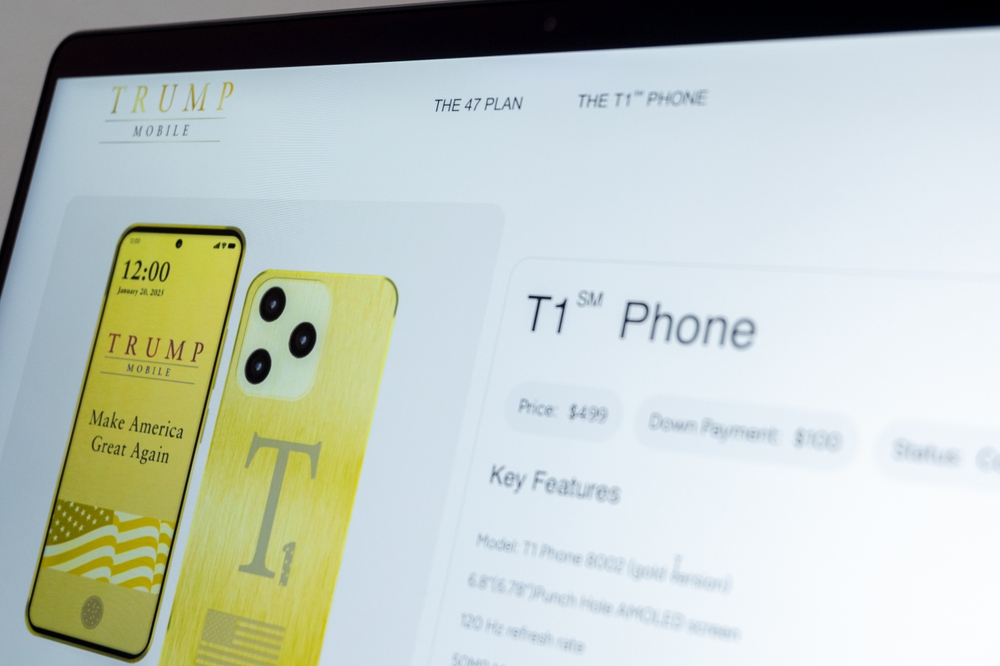

Gold gets away with a lot. It implies wealth, authority, permanence – the kind of finish that makes a $40 watch look like an heirloom and a fast-food restaurant feel like a destination. When a smartphone comes draped in gold and patriotism and the word “Trump” in raised lettering, the product almost doesn’t matter. The packaging is the product. The statement is the product. The phone is almost incidental.
That is the essential problem with the Trump Mobile T1, a gold-plated Android handset that has generated more controversy per feature than any consumer device in recent memory. Not because anyone expected it to compete with Apple or Samsung on hardware. But because the gap between what the T1 claimed to be and what it actually turned out to be is so spectacular, so perfectly complete in every detail, that it almost functions as its own kind of art form. The phone even came with an American flag on the back. All 11 stripes of it.
That detail, the wrong number of stripes on the flag of the country the phone was supposed to honor, says quite a lot about how the entire Trump Mobile venture has unfolded. Not because it’s the worst thing about the T1. It probably isn’t. But because it captures something essential about an operation that has been long on branding and short on execution from the very first press release, right through to the promotional video that appeared to feature an AI-generated rendering of the device, where eagle-eyed viewers counted nine stripes. The correct number is 13. They represent the original colonies. This is not trivia.
A Promise Made at Trump Tower
Trump Mobile was founded on June 16, 2025, by Donald Trump Jr. and Eric Trump, announced that same day at Trump Tower in New York City. The date was chosen because it marked the 10th anniversary of Donald Trump’s 2016 presidential campaign announcement – the brand’s creation as a kind of milestone celebration that also happened to involve collecting $100 deposits from the public.
The company initially announced that the smartphones would be exclusively manufactured within the United States, but about a week later, after analysts pointed to the lack of U.S. manufacturing facilities, that promise was quietly removed from the website. The replacement language went through several iterations, arriving eventually at the phrase “designed with American values in mind,” which is a thing you can say about almost anything, including a Walmart parking lot.
The T1 phone was redesigned three times before it reached anyone’s doorstep. At launch, the company’s website displayed a coverage map featuring the Gulf of Mexico, contrary to Trump’s own executive order to call it the “Gulf of America.” The map was subsequently removed. The phone that was supposed to be a statement about American pride launched with a map that used the name the president had just signed an order to change. The attention to detail was already evident.
The Deposit That May or May Not Buy You a Phone
Customers handed over an initial pre-order deposit of $100 to secure their slots, accumulating an estimated total pool of $59 million in advance capital, based on the 590,000 figure publicly cited by the company. That is a substantial amount of money to collect for a product that the company would later clarify it had no legal obligation to actually make.
The phone was first set to ship in August 2025. The launch was then pushed to November, then December. At the end of last year, customer service representatives told Fortune the phone would arrive in “mid to late January,” and that it was delayed because of the government shutdown. The government shutdown explanation drew attention immediately, given that Trump Mobile is a private company run by the president’s adult sons and has no formal connection to federal operations. The government shutdown did not delay the iPhone. It did not delay Android. It apparently delayed the T1.
The terms and conditions were updated on April 6, 2026, to state that the initial $100 payment did not guarantee delivery – only that customers would have the opportunity to buy the phone if it was manufactured. To be clear: after collecting roughly $59 million in deposits, the company updated its legal terms to clarify that those deposits did not mean a phone would ever actually exist. The comment section on Trump Mobile’s announcement post was turned off.
For the roughly 590,000 people who paid that deposit, the pre-order experience was something of a preview of what was to come. 404 Media journalist Joseph Cox reported technical and billing issues when pre-ordering the T1 Phone, including incorrect charge amounts and a failure to obtain the shipping address. Cox subsequently reported that Trump Mobile had made unauthorized recurring charges and had failed to provide customer service assistance.
The Phone That Arrived
When units finally shipped in May 2026, the packaging read “Proudly Assembled in USA.” Not made. Assembled. By February 2026, executives had confirmed that the phone would not be manufactured in the US. Final assembly of roughly the last ten components would occur in Miami, with bulk production happening overseas.
NBC News received one of the first review units and found the T1’s specifications match the HTC U24 Pro exactly – from its Snapdragon 7 Gen 3 processor and 6.8-inch OLED screen to its 512GB of storage. Shahram Mokhtari, an engineer at repair firm iFixit, told NBC the two devices are “physically very similar.” The HTC U24 Pro is a mid-range handset made in Taiwan and launched in 2024.
The $499 Trump Phone strongly resembles a Chinese phone that retails for less than $200 at Walmart. CNN separately noted the T1 closely resembles the T-Mobile REVVL 7 Pro 5G, a Chinese-made smartphone available at Walmart for $127.99 – roughly what customers paid as a deposit alone. To recap the math: customers paid $100 to reserve a $499 phone that may be functionally identical to a phone available at Walmart for $127.99. The Trump brand markup is doing considerable work there.
A comparison with similarly priced mid-range smartphones such as the Samsung Galaxy A57 and the Motorola Edge 2025 shows the Trump T1 Phone offers average features at best – from a Snapdragon 7 series chip to a 5,000 mAh battery that cannot be charged wirelessly, to a telephoto camera that only offers 2x zoom. The biggest weakness, however, is that the smartphone ships with Android 15, even though the launch of Android 17 is imminent. Trump Mobile does not guarantee Android updates or security patches.
The service plan that comes with the phone costs $47.45 a month, a figure chosen as a nod to Trump’s status as both the 45th and 47th president. For those keeping track, that is a monthly fee attached to a mid-range phone running an OS that is already two generations behind – with no promise of updates. You are, in a sense, paying $47.45 a month to stop receiving them.
Eleven Stripes
The T1’s rear casing displays a stylized American flag, but the design has only 11 red and white stripes rather than the 13 that have represented the original colonies since 1777. Promotional videos posted by Eric Trump and Donald Trump Jr. showed as few as nine stripes in certain shots.
The Verge reported that the promotional video showed the American flag with both 11 and 9 stripes in different frames, and that the inconsistent stripe count is almost certainly the result of AI-generated imagery. The inconsistency between shots suggests the video was produced with generative tools that rendered a flag convincing enough to approve but not quite correct enough to be correct. A device sold on the strength of its patriotic identity, with an AI-hallucinated version of the American flag printed on the back. It’s the kind of detail that writes its own punchline and then keeps writing.
Trump Mobile has not responded publicly to questions about the stripe count. The correct number is 13. The 13 stripes represent the 13 original colonies – a fact that appears in every American history textbook, on every flag flown from every school, courthouse, and front porch in the country. It did not make it onto the back of the phone built to honor American values.
Lawmakers, Regulators, and the Conflict Question
The T1 was not just a consumer product in a political climate – it was, critics argued from the start, a brand extension running inside the White House. Democrats, ethics groups, some members of Congress, and media critics largely reacted with skepticism and concern to the launch of Trump Mobile, raising ethics, consumer protection, and marketing-accuracy concerns. Critics and watchdogs argued the venture blurs Trump’s private business interests and his public role, calling it a conflict of interest.
In January 2026, a group of Democratic lawmakers asked the Federal Trade Commission to investigate the mobile phone venture for “potential violations of consumer protection law,” alleging that the advertising and sale of a supposedly “Made in the USA” phone may be deceptive. Senator Elizabeth Warren and 10 other Democratic members of the House and Senate asked regulators to examine whether consumers were cheated by paying $100 deposits for phones that had yet to materialize.
As of May 2026, the FTC has not publicly confirmed whether a formal investigation has been opened. California Governor Gavin Newsom’s office described the project publicly as appearing to be “FRAUD.” The comment sections remained closed.
Read More: The Little Boy in This Photo Is Young Donald Trump, But Almost Nobody Can Tell
The Gold Standard
Here is what the T1 phone actually is, stripped of the press releases and the patriotic packaging: a mid-range Android device, likely based on existing Taiwanese or Chinese hardware, assembled in Miami, running a two-generation-old operating system, with no guarantee of future software updates, carrying an American flag with the wrong number of stripes, sold for $499 to people who paid $100 a year ago for the privilege of maybe getting one, under terms the company quietly revised to confirm they were never legally obligated to deliver anything at all.
And still, 590,000 people signed up. That figure says something real about what the Trump brand does and how it does it – not as a punchline, but as a data point. The phone was never really about specifications. It was about identity, about buying something that said something. A gold phone with a flag on it and the word Trump in gold lettering. The tech was almost beside the point. What customers were purchasing was a statement of allegiance, and the company understood that well enough to collect $59 million before a single unit shipped.
The statement that ended up on the back of the phone, with its 11 stripes where 13 should be, is an accidental summary of the whole enterprise. The symbol of the thing, rendered imperfectly by an algorithm that didn’t know any better, approved and shipped and sent out into the world as-is. The gap between what was promised and what arrived is where the whole story lives. And for the people who put down $100 on faith, that gap is not abstract. It is a line item on a credit card statement, a customer service call that went nowhere, a shipping notification that may never come. The gold finish stays gold regardless. That much, at least, was always true.
AI Disclaimer: This article was created with the assistance of AI tools and reviewed by a human editor.