
On a residential street in New Haven’s Hill neighborhood, a pale-green house sits behind a wooden fence posted with a handwritten notice: “You are entering a human rights zone.” Most neighbors walk past without a second glance. But step through the gate into the backyard and you are looking at something the city of Connecticut has spent years trying to shut down, legislate around, and ultimately cannot seem to get rid of – because what is back there works.
The Rosette Neighborhood Village Collective is the creation of Mark Colville and his wife Luz Catarineau, who have lived and worked out of the Amistad Catholic Worker House at 203 Rosette Street since 1994. The couple founded the Amistad Catholic Worker House in New Haven in 1994, operating it as a center for advocacy inspired by Catholic social teaching. For three decades, the house was a hub of mutual aid in one of New Haven’s most under-resourced neighborhoods. Then came the pandemic, a bulldozer, and a decision that changed everything.
In the pandemic-induced chaos of 2020, New Haven closed its homeless shelters. Amistad responded by setting up an encampment in a park by the West River, which Colville estimated housed hundreds over three years. On March 10, 2023, the city announced its intention to demolish the encampment within a week, citing public health violations relating to fire and sanitation. Colville’s response was not to comply. It was to open the backyard.
The Backyard Becomes a Neighborhood
In March 2023, after the city swept the nearby homeless encampment that Colville had helped establish in 2020, he invited those he calls the “refugees” to set up their tents in Amistad’s backyard, joining others who were already staying there. Word spread through New Haven’s unhoused community the way most urgent information does – person to person, quickly. In response to the crisis, Amistad opened its backyard as a refuge where unhoused people were welcomed to tent, free from the fear of eviction and harassment. The response was overwhelming.
What made Rosette different from the start was its insistence on treating residents as neighbors rather than as a problem to be managed. As America Magazine reported in April 2026, Colville put it this way: “Where you put your tent down is your land. And that’s a qualitative difference, because when you have a place that’s yours, when you have a legally sanctioned place to be, that makes you a neighbor.” That framing – not charity, not shelter, but neighborliness – became the governing philosophy of everything that followed.
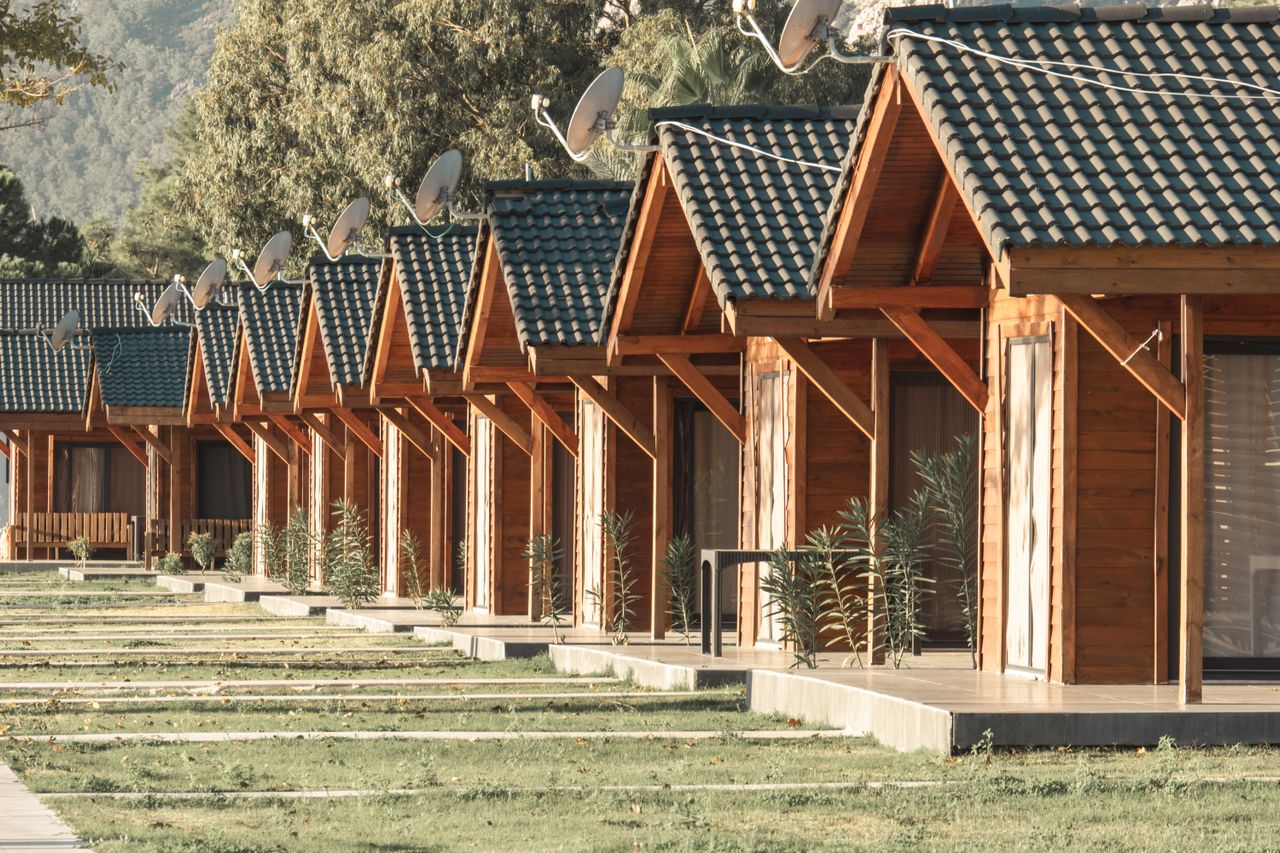
Seven months after the first tents went up, six tiny, white, prefabricated metal structures providing shelter for eight residents – “and a door that locks,” Colville emphasizes – were built over a weekend by community volunteers on one side of the yard. The cost of each unit was substantial but not prohibitive: the prefabricated pallet shelters ran between $10,000 and $15,000 landed and installed, could be constructed in about an hour, and were designed with a life expectancy of over ten years, weather-resistant and capable of functioning in cold climates with storage and heating capacity.
A Community Built on Rules, Not Charity
The picture that often gets attached to a story like this is passive – people given a place to sleep, grateful recipients of generosity. Rosette is not that. Village life is filled with chores scheduled and organized by resident leaders. Weekly meetings, on Tuesdays at 8:30 a.m., are mandatory for all residents. Ignoring chores and continued absence is grounds for expulsion, traditionally debated and voted on at those same meetings.
The structure was intentional. Colville has been clear about what he sees as the goal: “My main interest is in people developing their skills as leaders,” he has said – so they can know their rights and connect with others who can fight alongside them. The village operates less like a shelter and more like a small self-governing community, with residents shaping the norms they live by. Residents met with Colville to set community standards, including a nightly quiet hour.
For the people living there, the difference from the official shelter system is not abstract. As resident Suki Godek said in the Connecticut Public documentary Where Then Shall We Go?, “A shelter is very much like being in a jail. You’re giving up your rights to privacy, your rights to your possessions, to your ability to come and go as you please.” That documentary captured how village residents formed a functioning community in the Amistad backyard. The contrast Godek described is one that anyone who has spent time near homeless services will recognize: official systems often strip the same dignity they promise to restore.
The physical reality of what stability means came into focus through one resident in particular. After being unhoused for two years, Joel Nieves was able to use his sleep apnea machine for the first time at Amistad’s backyard shelter. Access to electricity, a dry place to sleep, and a door that locks are not luxuries. For someone managing a medical condition from a tent under an overpass, they are survival.
The City’s Response
The story of the homeless village in Connecticut did not unfold without friction. When the small homes went up, city officials sent a cease-and-desist order. After months of negotiations, once the state of Connecticut agreed that the village was a benefit to New Haven residents, the city granted a six-month zoning approval so residents could get through the winter. That approval came with conditions – and an expiration date.
The city’s zoning board granted Rosette Village a 180-day approval, backdated to the date of construction. When that window expired in July 2024, the city cut off electricity to the village. City officials maintained that the homes did not meet the safety criteria required for permanent structures.
The timing of the power cut, in mid-summer, did not spare residents from its effects. When the city shut off power to the tiny homes, Nieves – who depended on electricity for his sleep apnea machine – said to the New Haven Independent, “What am I going to do? I’m nervous because I don’t know how I’m going to sleep tonight.” For advocates, this was the cruelest part of the bureaucratic impasse: the rules designed to protect residents were being used against them.
By the fall of 2025, the situation had drawn state legislators into the fight. Progressive members of the state legislature spoke at a press conference with the Rosette Village Neighborhood Collective. State Representatives Josh Elliott and Laurie Sweet, both Democrats from Hamden, said they wanted to pass legislation making it easier to replicate the Rosette model of addressing homelessness and to introduce other protections for the unhoused population.
Why New Haven, Why Now
The urgency around Rosette Village is inseparable from what is happening to homelessness across Connecticut more broadly. According to a September 2025 report from CT Mirror, Connecticut’s homeless population grew for the fourth consecutive year from 2024 to 2025. The state’s latest point-in-time count recorded 3,735 people living in shelters or outside in January 2025, compared to 3,410 in January 2024 – nearly a 10 percent increase.
The unsheltered numbers tell an even more alarming story. The number of people living without any shelter at all rose from 574 in 2024 to 833 in 2025, a 45 percent increase confirmed by CT News Junkie in September 2025. These are not abstract statistics – they represent people sleeping under overpasses, in doorways, in cars, in precisely the kinds of encampments that cities have been sweeping and clearing for years without any durable resolution.
As Sarah Fox, chief executive of the Connecticut Coalition to End Homelessness, put it: “The overall trend from this year’s count shows that the inflow of people into the homeless response system is more than providers of shelter and services can keep up with.” The system is not failing at the margins. It is failing at the center.
As the community at Rosette evolved from tents to tiny homes, it sparked a lengthy public debate over how to handle the city’s housing crisis, and whether makeshift outdoor housing can help solve it. That debate has no clean resolution. But it has a very specific address: 203 Rosette Street, where the question is no longer theoretical.
How the Community Came Together
From the beginning, Rosette was not built by one couple alone. A group of community members – mental health professionals, faith leaders, writers, scholars, business leaders, people experiencing homelessness, and students – united to elevate the living standard of the backyard residents, calling the micro-neighborhood the Rosette Neighborhood Village.
Fundraising happened in places that might seem unlikely for a radical housing experiment. A fundraiser held at Guilford First Congregational Church, roughly 100 attendees deep, raised money for the six tiny houses – a wealthy shoreline suburban community pulling out all the stops for a housing activist from one of New Haven’s most under-resourced neighborhoods. The Colville name was not the only one attached to the project’s expansion, either. A neighbor purchased the property next door to the Amistad House and opened that backyard to unhoused individuals as well.
The village is volunteer-built and community-run, privately funded through small donations – not a single cent of taxpayer money. For Colville, that matters in a practical sense: the village does not compete with city services or drain public funds. It fills a gap that the official system cannot or will not fill. Other social services institutions that are at capacity regularly send people to Rosette.
Tiny home villages have appeared elsewhere across the United States, in cities like Madison, Wisconsin, and Portland, Oregon – and volunteer-funded housing models have taken root in other forms nationwide. But the Rosette model is distinct in its emphasis on governance by residents themselves, and in its refusal to be absorbed into the bureaucratic frameworks that typically define homelessness services.
The Entrance Sign Says It All
The welcome sign at Rosette Village reads, simply: “You Are Entering a Human Rights Zone.” The Connecticut State Legislature recognized homelessness as a public health crisis in June 2023, but recognition and response are not the same thing. The sign is not a legal designation. It is a statement of intent, and it has been tested repeatedly by city officials, zoning boards, and power shutoffs. It is still there.
Mark Colville has compared the model to a refugee camp: “If there was a disaster in New Haven and hundreds of families had to leave their homes, where would they go? They’d go to a refugee camp where you have a central facility surrounded by satellite units of housing. That’s what we’ve been doing here.” To Colville and many of the residents, homelessness – and the city’s response to it – has become a disaster of its own.
What This Keeps Coming Back To
The village operates on a simple premise: people experiencing homelessness deserve dignity, safety, and access to community. Providing these basics affirms their humanity, improves their health and wellbeing, and establishes a foundation from which they can seek permanent housing. That is not an original idea. What makes Rosette unusual is the degree to which it actually delivers on it – on a shoestring, without permits, in someone’s backyard, in defiance of a city that has tried several times to make it stop.
The debate around Rosette is often framed as a tension between compassion and code, between a couple who want to help and a city that has rules about what helping looks like. That framing is not wrong, but it leaves something out. The people in those six tiny structures did not disappear when the city cut the power. They got colder. The city’s obligation to enforce building codes does not expire the problem; it just relocates it. And every time an encampment is swept, the people in it end up somewhere – often, somewhere worse.
New Haven’s newest shelter, by contrast, was a converted Days Inn motel the city purchased for $6.9 million, at $121,000 per room. Rosette’s tiny homes cost between $10,000 and $15,000 each, built in a weekend by volunteers, funded by neighbors and church basements and small donations. The math is not complicated. What is complicated is everything the math leaves out: the door that locks, the quiet hour, the Tuesday meetings, the sleep apnea machine finally plugged in after two years. None of that appears in a cost-per-room calculation. It registers in whether someone considers themselves a neighbor or not.
Disclaimer: This information is not intended to be a substitute for professional medical advice, diagnosis, or treatment and is for information only. Always seek the advice of your physician or another qualified health provider with any questions about your medical condition and/or current medication. Do not disregard professional medical advice or delay seeking advice or treatment because of something you have read here.
AI Disclaimer: This article was created with the assistance of AI tools and reviewed by a human editor.