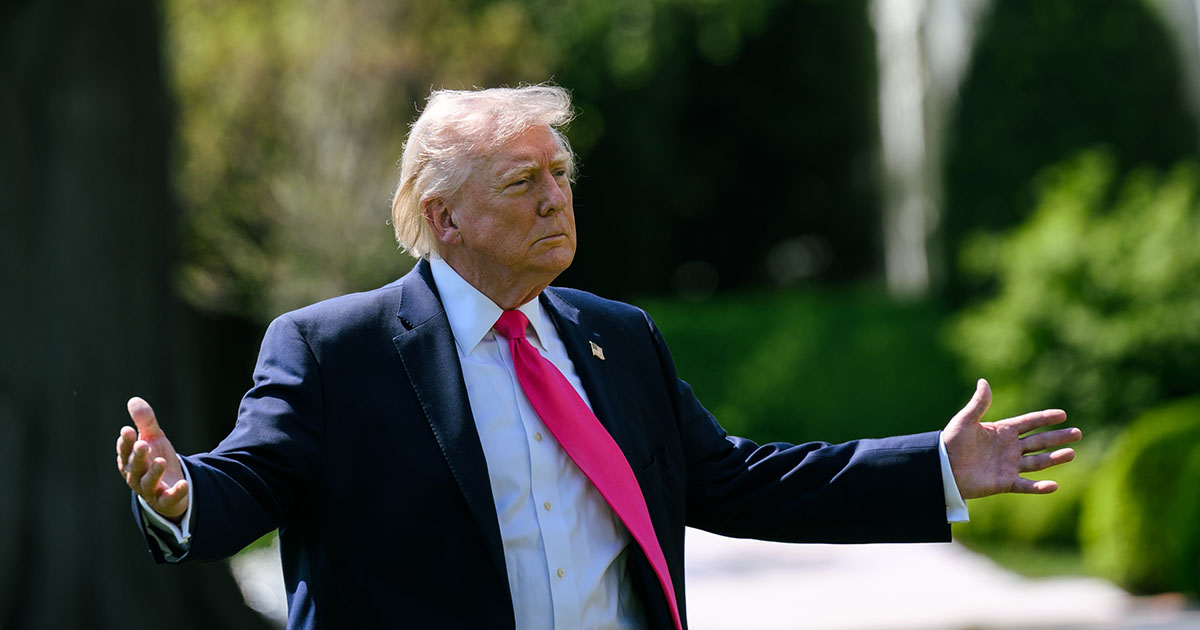

Donald Trump has called himself a lot of things over the years, but “the greatest communist in history” wasn’t on the expected list. On June 26, 2026, at the Faith & Freedom Coalition’s annual Road to Majority conference in Washington, D.C., the president delivered a deadpan, theatrical impression of a far-left politician promising free housing, free rent, and free food to every American. The crowd laughed, mostly. Trump called it easy to sell. He also said it would destroy the country within a few years, and that everyone would suffer or die. So, a joke. Mostly.
Trump was speaking at the Washington Hilton at a convention whose blending of religious language and campaign rhetoric is a recurring feature of his appearances before evangelical audiences. The Faith & Freedom Coalition has long served as a key organizing hub for conservative evangelical voters, particularly in presidential and midterm election cycles. This marked his 10th appearance at the Road to Majority event. The man knows his room.
While Trump routinely deploys the “communist” label against his political adversaries, the Road to Majority speech took a sarcastic detour that immediately exploded across social media. He slipped into character mid-speech, embodying what he described as his hypothetical communist campaign platform, and the audience’s laughter confirmed that the joke landed exactly where he intended it to.
What He Actually Said
Trump told the crowd, “Communism is very easy to sell. It destroys everything, but it is very easy. And I’ll be honest – I think I’d be the greatest communist in history.” He then laid out what his fictional communist campaign platform would look like. Slipping into the impression, he described promises of no rent, free houses for the taking, and free food for everyone. He added: “I’m telling you, I’d be the greatest communist in history. It would be so easy. You wouldn’t have to work. You could stay home.” He then clarified he wouldn’t actually go that route, as it never works.
He suggested that as a communist, he could offer free rent, houses, and food, though he warned that the country would fail within a few years, adding, “Everyone will suffer or die.” The crowd laughed. The point was that communism is only appealing until it isn’t, and that the people currently running on left-wing platforms either don’t know that or don’t care.
The New York Trigger

The riff was triggered by recent local election results in New York City, where candidates backed by democratic socialist Mayor Zohran Mamdani swept primary contests earlier in the week. All three progressive candidates backed by Mamdani, including two who took on Democratic incumbents, won their primaries in safe seats, almost guaranteeing their election in November. The biggest upset came in New York’s 13th district, where Mamdani-backed candidate Darializa Avila Chevalier, a 32-year-old community organizer and democratic socialist, narrowly defeated five-term incumbent Democrat Adriano Espaillat to represent Upper Manhattan and part of the Bronx.
Tuesday’s primaries represented a major political gamble for the 34-year-old mayor, whose strength is surging, and a potential headache for Democratic leaders who fear that Mamdani and his loyalists may push the party too far left ahead of November’s midterm elections. Trump pointed to the New York City primary results as evidence that the Democratic Party’s left wing had moved beyond social democracy, framing the winners as representatives of a more radical tendency.
Republicans had already been reaching for exactly this line. The National Republican Congressional Committee stated that Tuesday “was the night the Democrat establishment officially surrendered to Zohran Mamdani and the socialist wing of their party.” Trump arrived at the Faith & Freedom Coalition podium ready to amplify that message, and the “greatest communist” line was his most attention-grabbing instrument for doing so.
The Anti-Communist Sermon
The joke took up only a few minutes of a much longer speech. The rest was darker in register and considerably less playful. Trump doubled down on dehumanizing rhetoric against the far-left wing of the Democratic Party, explicitly warning the crowd of religious conservatives that modern socialists pose a direct, existential threat to the survival of American Christianity.
He claimed that these individuals want to end religion because their ideology cannot work alongside strong faith. “All communists are godless. They do not believe in God,” he stated, warning the crowd that if these political opponents gain power, they would move to close churches and persecute Christians. He told attendees: “We have to stop this, this horrible thread of cancer that’s permeating our country called communism.”
He told the audience that the country faced “the most serious threat since its existence,” language he often uses to describe political opposition. For a crowd of evangelical Christians gathered to strategize ahead of midterm elections, the message was crafted with precision: voting in November isn’t just political, it’s a matter of spiritual survival. Trump reflected on the nation’s upcoming 250th anniversary, highlighted what he described as victories for religious liberty, and urged supporters to remain politically engaged ahead of the midterm elections.
House Speaker Mike Johnson also addressed the conference, claiming the foundations of the country were under violent attack. He pointed to the rise of what he called “little mini-Mamdanis” running for office across the nation, and argued that the energy in current politics was fueling an insurgent left openly running as Marxists and communists — threats he said were once tied to the Cold War but were now present at home.
The Rhetorical Pattern Behind the Punchline
The speech underscored a familiar rhetorical pattern: Trump’s tendency to elevate political messaging through superlatives. Whether describing himself as the “best,” “greatest,” or in this case, the “greatest communist,” the language functions less as ideological positioning than as amplification of political contrast. The self-deprecating joke, I could do this, and I’d be great at it, but it would ruin everything, is a well-worn rhetorical move. You claim the enemy’s territory in order to destroy it.
Trump defined “communism” not as a political or economic system, but as a set of campaign promises centered on government-provided benefits. That redefinition collapses the distance between rent stabilization policy and Stalinist collectivization into a single, interchangeable category. Whether that conflation is intellectually honest is a separate question from whether it’s politically effective, and the speech was clearly designed to demonstrate that it is.
With Mamdani’s candidates winning in New York and the Democratic Party’s internal fault lines fully exposed, Trump’s team has a ready-made contrast to deploy heading into November. The remarks came as part of a broader pattern in which Trump repeatedly described Democrats as “godless communists” and warned that their policies posed an existential threat to the United States. The communist label is the frame, and everything from rent control to healthcare policy gets crammed inside it.
During the same speech, Trump acknowledged that NYC Mayor Mamdani “seems like a nice guy,” but insisted his push to make rent more affordable would backfire, warning that “these buildings will soon turn into ghettos and slums.” The compliment and the catastrophizing arrived in the same breath.
For anyone watching the Trump voters regret conversation closely, the speech offers a window into how the White House plans to keep its base energized through November, not with policy details, but with the oldest available political tool: a clear enemy, described in the starkest possible terms.
The Faith Audience and the Midterm Stakes
Ralph Reed, the founder and chairman of the Faith & Freedom Coalition, has built the organization into one of the most effective evangelical mobilization networks in Republican politics. Reed has been running this playbook for three decades, and he knows which levers move evangelical voters. The combination of religious identity under threat and a looming election is one of the most reliable mobilization tools in American conservative politics.
This was also Trump’s first time speaking at the Washington Hilton since the White House Correspondents’ Dinner shooting. Reed introduced Trump at the event and described him as “a man who, alone among all the leaders that we have had, gave us the most conservative Supreme Court in over a century.” The crowd was not hard to read.
Read More: The U.S. Is Trying to Denaturalize Citizens at Record Scale with Largest Effort Ever Made
What the “Greatest Communist” Line Is Really About

The Trump communist comments from the Faith & Freedom Coalition speech represent the opening salvo of a midterm messaging campaign built around a single proposition: the Democratic Party has moved so far left that the only honest way to describe it is with a word that, for most Americans over 50, still carries the weight of an existential Cold War threat. The joke is the delivery system. The warning is the payload.
The actual policy platforms of Brad Lander and Claire Valdez centered on rent stabilization, expanded healthcare, and foreign policy accountability, not the abolition of private property. Trump’s approach erases those distinctions entirely, which is precisely how it functions. The evangelical crowd at the Washington Hilton on June 26 laughed at the joke and heard the warning underneath it. You hold both things at once: the absurdity of the president calling himself the greatest communist in history, and the very deliberate infrastructure being built around it for the next four months.
AI Disclaimer: This article was created with the assistance of AI tools and reviewed by a human editor.