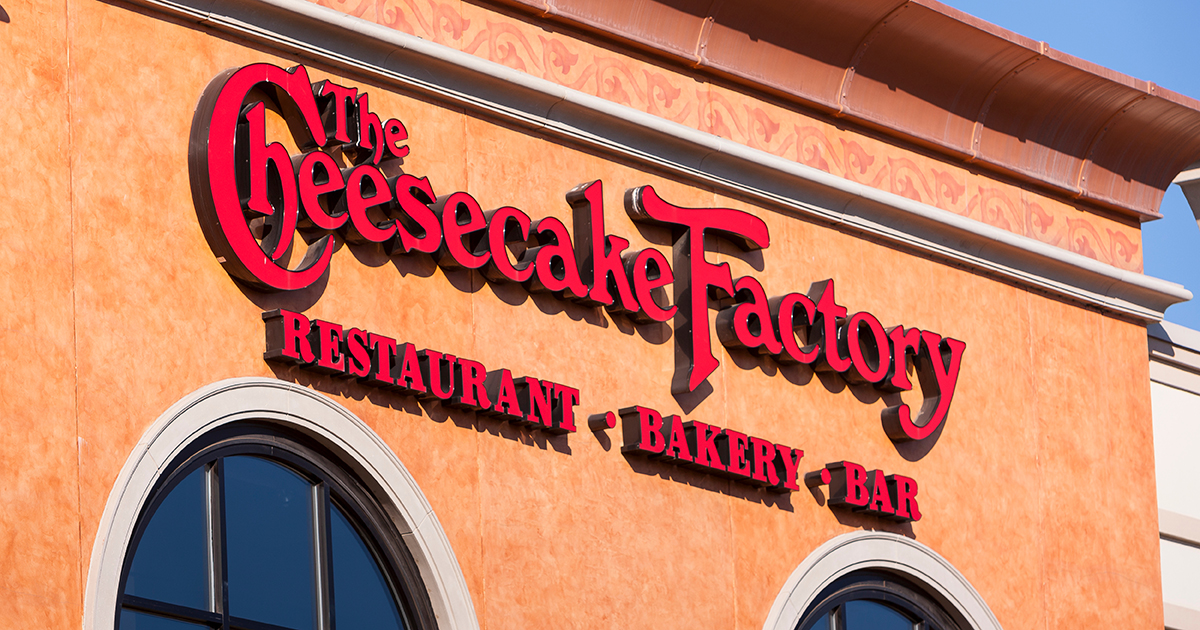

Pick up any menu at The Cheesecake Factory and you’ll understand, within about thirty seconds, why the restaurant industry spent decades insisting the place shouldn’t work. The thing is dense. It’s laminated. It has sections. It has sub-sections. It runs to 21 pages and lists more than 250 made-from-scratch items – steak, gumbo, tacos, stir-fry, pizza, pasta, ceviche, and chicken shawarma all on the same card – and clocks in at roughly 5,940 words, which is about a third of the length of Macbeth. Consultants have a term for what you’re supposed to do with a menu like that. They call it a problem.
And yet the restaurant keeps filling up. Every table. Every night. In over 200 locations across the United States. The family that can never agree on a place to eat ends up there. The birthday parties land there. The first dates that need a safe default go there. The Cheesecake Factory has somehow turned its most glaring theoretical weakness into its most reliable draw, and the story of how it pulled that off is more interesting than the menu itself – which, given the menu’s word count, is saying something.
The conventional wisdom in restaurant design is tight: a focused menu cuts food waste, speeds up kitchen operations, sharpens a concept’s identity, and keeps customers from freezing in front of too many choices. Trim the menu, the thinking goes, and everything gets better. The Cheesecake Factory looked at that wisdom and went in the other direction so hard it essentially created its own category.
The Man Who Didn’t Know the Rules
Cheesecake Factory founder David Overton designed the original menu around items he taught himself to cook, without a formal culinary background. That lack of training turned out to be an asset. Overton has said the early goal was simply a menu built around the cheesecakes, and that because he wasn’t a chef and had no restaurant experience, he made sure everything served was something he could make himself – a policy that removed the fear of a trained kitchen team walking out and taking the recipes with them. As Overton developed a real knack for cooking and experimented with more complex dishes, he kept adding them to the menu, and it kept growing.
What he also noticed, eating at other restaurants during those early years, was that the gap between fine-dining complexity and casual-dining pricing was wider than it needed to be. He started bridging it. Dishes that belonged in white-tablecloth rooms started appearing at prices that worked for a weeknight out. The menu grew not because anyone had a theory about it, but because customers kept responding. The theory came later, when analysts started trying to explain why the thing worked at all.
The Problem That Isn’t Actually a Problem
Behavioral economics has a famous data point that gets deployed against large menus constantly. The paradox of choice – Iyengar and Lepper’s 2000 jam study – found that shoppers shown 24 jam varieties were one-tenth as likely to buy as shoppers shown just six. By that logic, a menu with around 250 items across 35 sections and 21 pages should be a catastrophe for sales. The Cheesecake Factory does roughly $3.75 billion a year in revenue.
The resolution isn’t that the jam study was wrong. It’s that it measured a specific condition – a stranger choosing alone from an unfamiliar set, with no social scaffolding around the decision. A 2010 meta-analysis of fifty choice-overload experiments found the average effect was close to zero: overload is real in some conditions and absent in others. The Cheesecake Factory operates in almost none of the conditions where overload bites. Nobody arrives there having never heard of it. Nobody has to commit to a cheesecake flavor before they’ve eaten. The menu is enormous, but it’s also familiar – the kind of enormous where you already know what section you’re heading to before you sit down.
The roughly 250 items also function as what some analysts call veto-proofing: a long menu guarantees something for every person in a group, which is why mixed parties with incompatible preferences reliably land there. And the sheer heft of the thing works as free marketing, signaling abundance and confidence and generating press coverage the chain never had to buy.
Overton himself has put it, “Cheesecake has always played well on the price point because of so many different options for guests,” including “the size of the portions that allows people to share and have leftovers for the next day.” That is not an accident of generosity. It’s a pricing strategy that removes the sting of a check that would otherwise feel steep.
What the Cheesecake Factory Menu Actually Contains
The menu runs across about 20 pages and features around 250 items, but despite the name, only a small fraction is actually cheesecake – over 30 varieties, according to the chain’s own menu count. The remaining 200-odd dishes cover territory including tacos, pastas, burgers, gumbo, grilled fish, steaks, stir-fries, meatloaf, salads, pizza, and fried chicken.
There are also breakfast dishes on weekends, “Skinnylicious” options for calorie-conscious diners, and cocktails spanning mojitos to spritzes. The dessert menu alone offers over 30 cheesecake flavors and cakes, milkshakes, and specialty ice cream desserts.
The menu also changes twice a year, with recent updates swapping out items like white chicken chili and ahi tuna salad in favor of ceviche and chicken shawarma, though the total item count reportedly stays around that 250-item ceiling. That rotation matters. In 2025 alone, the chain added 20 new items in March, then followed that with 14 more additions in a second wave – though it also cut 13 items to keep the menu calibrated. The size of the Cheesecake Factory menu feels static to a diner who visits once a year. Behind the scenes, it’s constantly edited.
The Kitchen Nobody Believes Is Real
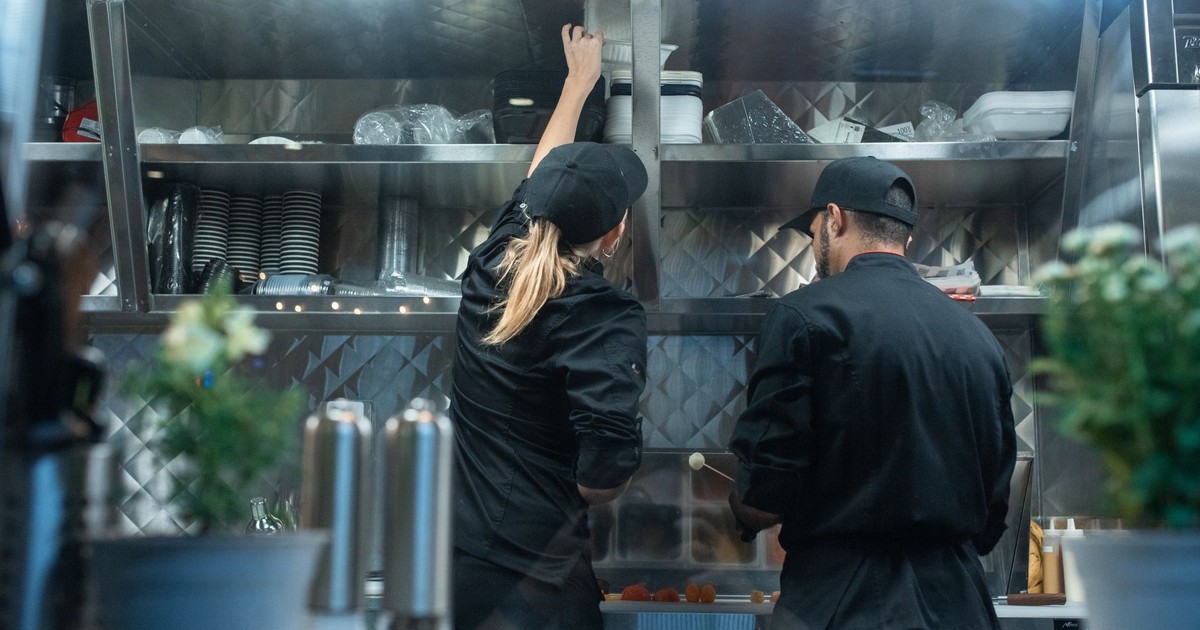
The most common conspiracy theory about the Cheesecake Factory is that the food must be frozen. The reasoning is intuitive: how could any kitchen keep that many raw ingredients fresh, let alone cook them all to order? The answer involves a prep operation that most diners never see and a kitchen architecture that has almost nothing in common with how smaller restaurants run.
Before customers arrive each day, kitchen staff chop vegetables, slice meats and cheeses, and roast tomatoes for sauces. At one prep station alone, employees make more than 100 sauces and dressings. The walk-in refrigerators – several of them, not one – hold not just raw ingredients but partially assembled components made in large batches. Marinara sauce, for instance, is produced days in advance in volume, then held and pulled as orders come in.
The line kitchen is organized into dedicated micro-stations for pastas, proteins, fried foods, and salads. When an order arrives, each station assembles and cooks its portion of the dish independently, and a finishing cook then plates and garnishes everything before it moves to the central line. An algorithm breaks down each table’s order and routes color-coded, precisely timed assignments to the appropriate stations – so a guest’s steak will start cooking well before their companion’s orange chicken, timing them to finish together. The expediter standing at the end of the line has final approval on every dish before it goes to runners.
At cooks’ stations, monitors mounted at eye level display flavor profiles and visual descriptions for whatever item is being prepared at that moment. That consistency infrastructure is why a Cheesecake Factory in Nashville and one in Phoenix will serve you the same chicken madeira the same way, at the same temperature, with the same sauce-to-portion ratio. The system is the recipe.
For its cheesecakes, the chain does something different. The restaurant’s most iconic item arrives frozen from centralized bakeries in Los Angeles and North Carolina, then gets finished in-house with fresh garnishes, sauces, and the restaurant’s signature whipped cream, prepared fresh at each location. Cake slices accounted for an estimated 17% of Cheesecake Factory sales in 2025. Centralizing the baking was a consistency decision as much as a logistics one – getting over 30 cheesecake flavors to taste identical across more than 200 restaurants, every day, is an engineering problem that a centralized bakery solves in a way an in-house kitchen simply can’t.
What the Numbers Say

The restaurant industry spent years treating the Cheesecake Factory as an outlier that would eventually correct itself. Instead, it just kept growing. In 2025, the company achieved record annual revenue of $3.75 billion, a 4.7% increase over fiscal 2024. In the first quarter of 2026, average weekly sales reached an all-time high.
That performance comes in a casual dining environment where many competitors have struggled to hold flat. Cheesecake Factory Chairman and CEO David Overton described 2024 as “an excellent year” marked by “record annual revenue and substantially improved profitability,” with comparable restaurant sales and traffic outperforming the broader casual dining industry. The company opened 25 new restaurants in 2025, a pace that reflects investor confidence in a model that most food-industry textbooks would have flagged as unsustainable.
The portion sizes are part of this. A check at the Cheesecake Factory looks reasonable when two people can split an appetizer, two entrees, and a slice of cheesecake and take food home. The value perception outlasts the actual bill. That’s a harder thing to engineer than a tight, focused menu, and the Cheesecake Factory has been doing it for decades without anybody fully crediting how intentional it is.
The Thing the Menu Is Actually Selling

Every few years, a food writer argues the Cheesecake Factory should slim down. The menu is unwieldy. It’s exhausting. It violates everything we know about elegant dining concepts. Those arguments are not wrong about what the menu is. They’re wrong about what it’s for.
The Cheesecake Factory menu is not trying to express a culinary identity. It’s not a chef’s statement or a brand manifesto. It’s a solution to a social problem: the impossibility of getting a group of people – with different budgets, different dietary preferences, and different appetites for adventure – to agree on a restaurant. The menu is 250 items long because that’s how many items it takes to make the answer to “where should we go?” feel obvious. The food is good, consistently good, but the real product is the certainty that nobody in your party will be unhappy before they even sit down.
There’s a reason the place became a cultural shorthand – the kind of restaurant that turns up in TV shows, gets booked for birthday dinners without discussion, and absorbs every office lunch argument before it starts. It didn’t get there by being daring. It got there by being the answer to an argument nobody wanted to have. That’s a strange kind of genius: building a $3.75 billion empire on the menu that every expert would have cut in half. The experts were not entirely wrong. The Cheesecake Factory just decided that, for its purposes, being right about restaurant theory was less useful than filling every seat.
Disclaimer: This information is not intended to be a substitute for professional medical advice, diagnosis, or treatment and is for information only. Always seek the advice of your physician or another qualified health provider with any questions about your medical condition and/or current medication. Do not disregard professional medical advice or delay seeking advice or treatment because of something you have read here.
AI Disclaimer: This article was created with the assistance of AI tools and reviewed by a human editor.