

Take a look at the grid below and count every square you can find. Take your time.
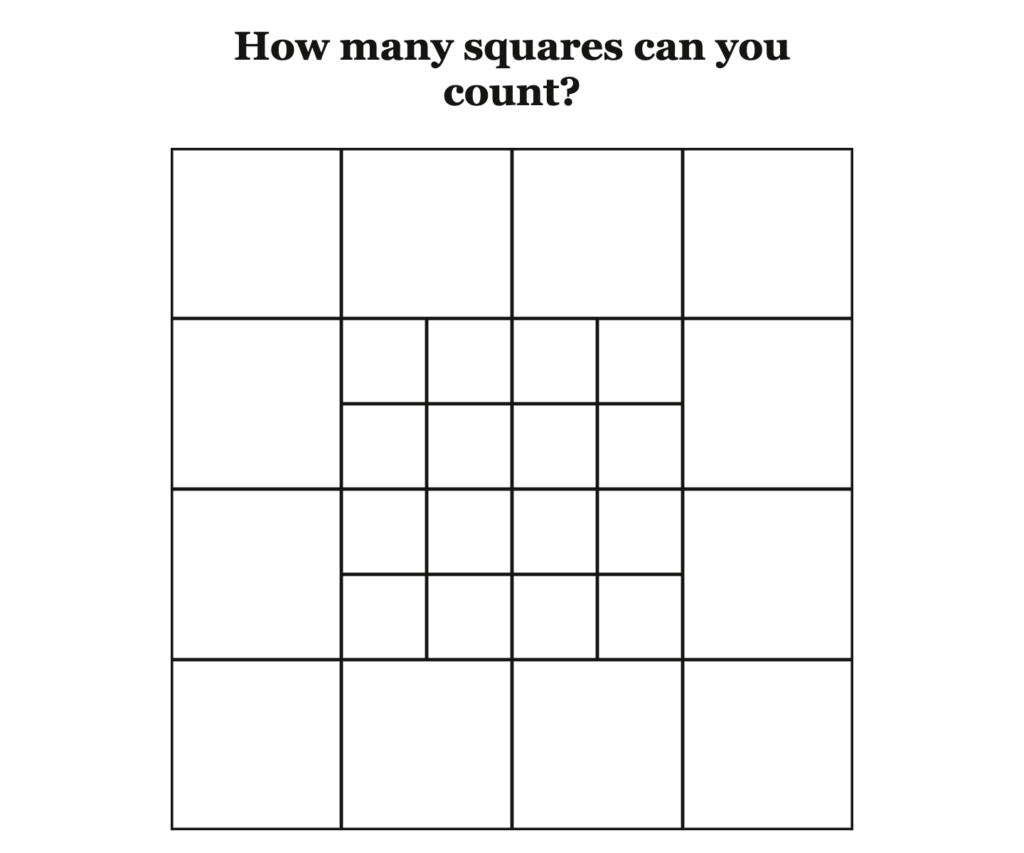
Write your number down before you scroll. Image by Claude (Anthropic) for Catherine Vercuiel, via claude.ai.
Got your number? Good, hold onto it because we will come back to it later. Most people who try this come up short, and the real total is higher than almost anyone expects on the first attempt. But before we get to the answer, think about the moment you decided you were finished counting. You landed on a number, it felt right, and you stopped looking. Most people do. Not because they worked through every possible combination, but because something in their head said the job was done. That tends not to be a careful decision. It’s a feeling, and the feeling is usually enough.
That reflex, where confidence shows up before the work is finished, is something researchers have spent over two decades trying to understand. And when they tracked which personality traits predict it most reliably, one stood out above everything else. It belongs to a cluster of 3 traits that psychologists call the Dark Triad, and the people who score highest on it don’t just trust their first answer too quickly. They never register a reason to go back and question it.
Why Your Brain Stopped Looking
The brain doesn’t process everything it sees. It runs on shortcuts, mental rules of thumb that cognitive scientists call heuristics. Most of the time, they work well enough that you never notice them. They’re the reason you can walk into a room and know where the furniture is without consciously measuring anything.
But they’re also the reason almost no one counts a grid like this one correctly. Psychologists have understood this since the early 1900s through a branch of research called Gestalt theory. Which found that the brain organizes what it sees into the most immediately visible groups and skips anything nested or overlapping. Your visual system picks up the small squares, maybe the outer border, and moves on because it already has an answer it’s satisfied with.
That tendency to stop at the first answer that feels complete doesn’t just apply to what you see. It shows up any time the brain has to judge its own performance, and certain personality types lean on that false finish harder than others.
In 1999, psychologists David Dunning and Justin Kruger ran a series of studies at Cornell where they gave people tasks in logic, grammar, and humor, then asked each person to estimate how well they did compared to everyone else. The people who scored in the bottom quarter consistently placed themselves near the top. Across all 4 studies, participants whose actual scores put them in the 12th percentile estimated they had landed in the 62nd. They weren’t lying or boasting.
They genuinely believed they had done well, and the reason comes down to something that seems obvious once you hear it, but is easy to miss in practice. To spot a mistake, you need to understand the material well enough to recognize that something is wrong. If you don’t have that understanding, the mistake doesn’t look like a mistake. It just looks like an answer. So someone who gets a grammar question wrong because they don’t know the rule also doesn’t know enough to realize their answer was wrong. Their incorrect answer feels exactly as solid as a correct one would. Because the gap between what they know and what they think they know is invisible from the inside.
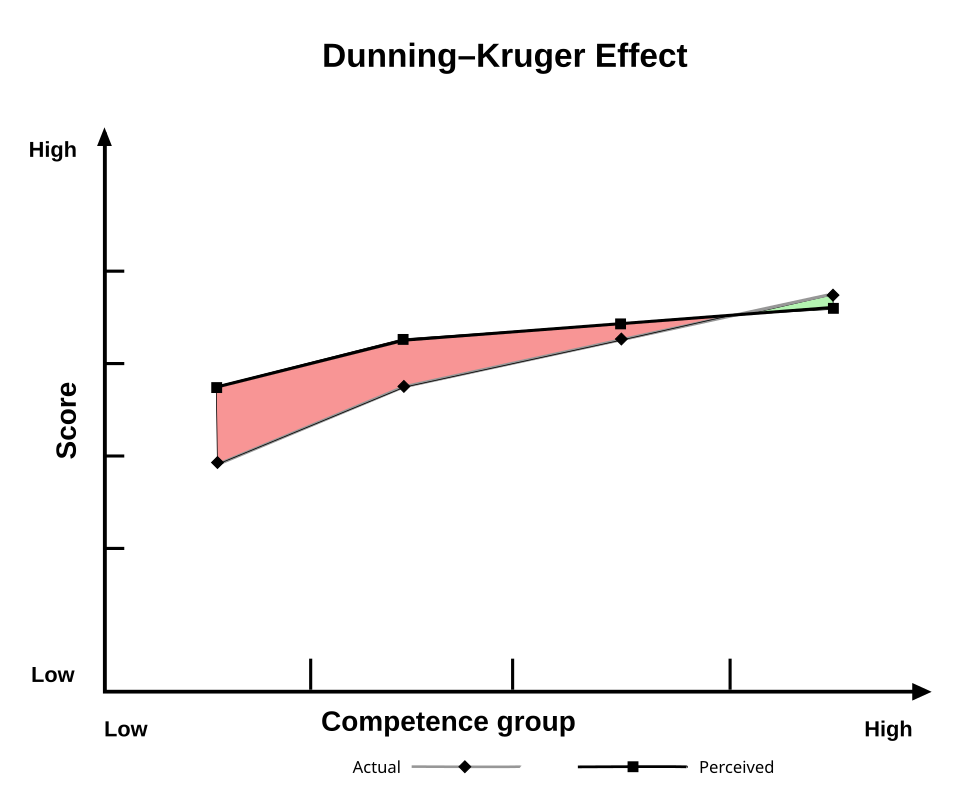
If overconfidence follows poor performance across logic, grammar, and humor, does it also show up in how people judge the quality of information itself? And if it does, does a specific personality trait predict who mistakes confidence for accuracy most often?
A 2025 study published in the journal Thinking & Reasoning addressed both questions. Vladimíra Čavojová, a researcher at the Institute of Experimental Psychology at the Slovak Academy of Sciences, worked with colleagues Jakub Šrol and Ivan Brezina to test over 1,000 adults on their ability to tell real wisdom from dressed-up nonsense. The team gave participants a mix of statements. Some were genuine quotes with real meaning, things like “A river cuts through rock, not because of its power but its persistence.” Others were built to sound wise while meaning nothing. Sentences like “Imagination is inside exponential space-time events” that carry the rhythm of something deep without saying anything. Participants had to sort the real from the empty, then rate how well they thought they did.
Just as Dunning and Kruger found with logic and grammar, the people who were worst at telling the difference rated themselves as the strongest performers. And the people who did best tended to underrate themselves. But Čavojová’s team went a step further. They measured personality traits alongside those confidence ratings, and one trait stood out above everything else.
The Personality Trait Behind the Certainty
Narcissism was the clearest predictor of that overconfidence. Čavojová’s team tested narcissism alongside two other traits that together form what psychologists call the Dark Triad. A term coined by Delroy Paulhus and Kevin Williams in 2002 to describe 3 personality traits that all involve putting yourself first at the expense of other people.
Narcissism centers on inflated self-importance and a constant need for admiration. Machiavellianism describes people who manipulate others strategically and treat relationships as tools rather than bonds. And psychopathy combines low empathy with impulsive behavior and a habit of making decisions without worrying about what happens next. None of these are diagnoses. They sit on a spectrum, and everyone falls somewhere on each one. Some researchers have since added a 4th. Everyday sadism, which describes people who get satisfaction from causing discomfort or pain in ordinary social situations. That expansion is sometimes called the Dark Tetrad.
Machiavellianism didn’t predict the confidence mismatch at all, and people who scored higher on it were better at the detection task. Even though they also admitted to faking their way through conversations more often themselves. Psychopathy didn’t predict it either. Only narcissism did, and it held up across both studies. People who scored higher on narcissism rated their own performance well above where it landed, which on its own could just mean they were optimistic. Although they weren’t just optimistic after the fact. Their first instinct became their final answer. Even though the task gave them every reason to slow down and think twice.
That overconfidence didn’t look like a superiority thing, either. People who scored higher on narcissism overrated their own performance but tended to rate others as fairly competent too. The inflation was personal, not competitive. They didn’t walk away thinking they were smarter than the people sitting next to them. They walked away thinking they had nailed it when they hadn’t, and nothing in how they rated everyone else suggested they needed to feel above anyone to get there. The disconnect wasn’t between narcissists and other people. It was between narcissists and their own results.
Self-esteem also predicted higher confidence ratings in Čavojová’s data, which raises the obvious question. If both traits make people feel sure of themselves, what separates them? People with high self-esteem felt confident about their answers but could still reconsider when pushed. Their self-assessment bent under pressure.
People who scored high on narcissism couldn’t do that. Because narcissistic confidence is built on avoiding doubt rather than absorbing it. Research published in the journal Psychophysiology found that even in children, narcissistic traits were tied to elevated physiological stress responses during tasks where their performance might be judged. High self-esteem was tied to lower stress in the same situations. People with high self-esteem could afford to be wrong. People with high narcissism couldn’t afford to question whether they were.
When Producing Nonsense Doesn’t Mean You Can Spot It
Narcissists weren’t the only ones in Čavojová’s data who produced dressed-up nonsense. People who scored high in Machiavellianism admitted to it too. Assembling impressive-sounding language they knew meant nothing just as often as narcissists did. But only the Machiavellians could catch it when someone else did the same thing.
Machiavellianism is built on using language as a tool for manipulation, so people who score high on it know what an empty sentence looks like because they’ve built plenty of them on purpose. Their nonsense production was deliberate and controlled, something they could pick up and set down depending on the situation. They knew when they were doing it, which meant they could also tell when someone else was. That awareness moved in both directions because it was a skill, not a reflex.
Narcissists couldn’t make that same distinction. They produced empty language just as often as Machiavellians did. But when a nearly identical sentence came back at them from someone else, they accepted it as genuine wisdom and felt confident they had sorted it correctly. Think back to the moment you stopped counting squares. Did you stop because you ran out of places to look, or because the number you had felt right enough to keep? If it was the feeling that made the decision, that’s the same reflex at work. People who scored high on narcissism trusted that feeling with information the same way you trusted it with the grid. Their confidence in their own judgment had nothing to do with how good that judgment was.
If overconfidence were just about wanting to look smart, narcissists would at least perform well on tasks they care about appearing good at, but the data didn’t show that. They performed the same as everyone else on the detection task itself. The only place narcissism made a measurable difference was in the self-rating afterward. The moment when people decided how well they had done. That confidence wasn’t compensating for poor performance. It was running on its own track entirely, showing up at the same level whether their scores justified it or not.
Narcissists had nothing to compare their confidence against. Their self-assessment floated free from their performance because it was never built on evidence in the first place. Machiavellians were the opposite. They scored higher on the detection task and their self-ratings tracked closer to where they landed, not because they were more humble, but because their confidence was tied to something they could point to. The difference between the two traits isn’t about who feels more certain. It’s about whether that certainty has anything underneath it. Machiavellians used empty language as a conscious strategy, so they could recognize the same strategy when it came from someone else. Narcissists used it without knowing they were doing it, and couldn’t tell the difference between their own hollow sentences and someone else’s genuine insight.
That fast certainty, paired with a self-assessment that doesn’t match the evidence, is what narcissism predicted across both of Čavojová’s studies. Not the wrong answer, but the unearned confidence that came with it. That doesn’t mean your square count says something about your personality. But the feeling that told you to stop counting, that quick satisfaction before the work was finished, is the same feeling these studies measured. And the people who scored highest on narcissism weren’t the ones who got the most wrong. They were the ones who never considered that they might have.
Why the Confident Answer Feels So Hard to Let Go
Confidence that comes after you’ve actually checked your thinking feels exactly the same as confidence that shows up before you’ve checked anything at all. Your brain doesn’t tag one as verified and the other as a guess. Both feel solid. Both feel like yours. And that’s why most people never stop to ask which one they’re working with. It’s also why learning about cognitive biases tends to feel like learning about what other people do wrong rather than something that applies to you personally.
Psychologists call the ability to tell these two apart metacognition, and it works like a monitoring system for your own thinking. When it’s strong, you can feel confidence building and ask yourself whether you’ve done the thinking to back it up before you commit to an answer. When it’s weak, you trust the feeling and move on, even when the answer is wrong.
Social psychologist Lee Ross spent decades at Stanford studying why that feeling is so easy to trust. In 1996, Ross and Andrew Ward published a chapter that named the tendency naive realism and broke it into 3 parts. The first is that people believe their perceptions are objective. From there, they expect other reasonable people to see things the same way when given the same information. And when someone disagrees, the automatic explanation is that the other person must be uninformed, irrational, or biased. All three feel like seeing clearly, and that’s what makes them so hard to question.
Those three beliefs line up almost perfectly with what narcissism does to self-assessment. The narcissists in Čavojová’s study had no reason to think they were wrong. Because their metacognition wasn’t catching the mismatch. So their confidence went unchecked. Naive realism was doing what it always does, treating the first reading as the accurate one, and narcissism made sure nothing interrupted it.
That doesn’t stop working just because someone knows about it. A person can study how overconfidence works, nod along with every finding, and still walk away convinced that they personally would have caught the vacuous sentences in Čavojová’s task. Knowing about a bias and being able to catch it running in your own thinking are two different skills, and the second one is far rarer than the first.
Think about the last disagreement you had where you were completely sure the other person was wrong. Ross would say that your certainty felt like clear-eyed perception. But it was running through every assumption and experience you carried into the conversation. The filter was invisible to the person using it. That’s naive realism working in real time. And it runs the same way whether you’re sorting wisdom from nonsense in a study or deciding over dinner that someone else’s argument doesn’t hold up.
The participants in Čavojová’s study who judged their own performance most accurately shared two qualities. They had strong verbal reasoning, the kind that comes from reading carefully and thinking about what words mean rather than how they sound. And they had a willingness to slow down, sit with not knowing, and reconsider a first response even when the first response felt solid. They weren’t the most confident people in the room. They were the ones willing to sit with a wrong-feeling answer long enough to test it. That patience was where their accuracy came from.
Which brings us back to the grid, and the number you’ve been waiting for.
Read More: Which Glass Will Fill First? Your Choice Reveals A Personality Trait
The Answer
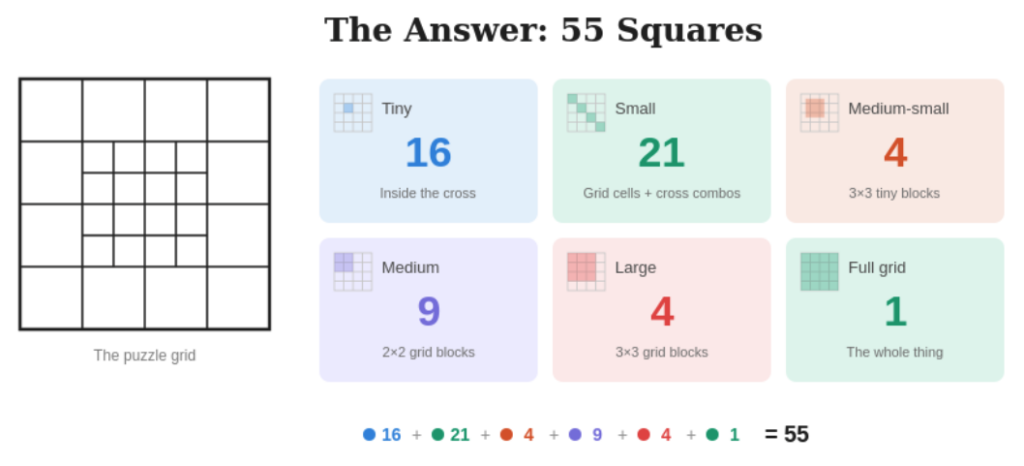
Six categories of squares sit inside the same grid, sorted here from the ones everyone finds to the ones almost nobody does. Image by Claude (Anthropic) for Catherine Vercuiel, via claude.ai.
The grid holds 55 squares, and the breakdown above shows where most people stop counting.
Most people find the 16 tiny squares first because those are the most visible individual cells. Some catch the outer border, which gives them the single full grid square. But the 21 small squares, the ones formed by combining grid cells with the cross pattern, are where most counts start falling short. And almost nobody gets the 9 medium squares or the 4 large ones on a first attempt. Because those require seeing the grid as a set of overlapping frames rather than a collection of individual boxes.
So how close were you? And more importantly, what happened when you saw the real number? If 55 was higher than yours, you probably felt something shift. Maybe you started scanning the image for the squares you missed. Or maybe something pushed back against it. Not because you had a reason to doubt the count, but because your first number still felt right.
That push-back is what Čavojová’s research kept measuring. The participants who scored high on narcissism got the same number of answers wrong as everyone else. The difference was that nothing in how they felt afterward told them to go back and check. Their confidence showed up before they had looked at anything closely, and it was strong enough that nothing after the task could budge it. The feeling of being right did the same job as being right, and they couldn’t tell the difference.
The grid is a small, contained version of something that happens all the time. Every quick judgment your brain makes runs on the same shortcuts, and most of them finish before you’re aware they started. Your brain is always going to take those shortcuts. That part doesn’t change. What can change is whether you notice one has already made a decision for you and decide to look again before you commit to it.
The participants in Čavojová’s studies who judged their own performance most accurately weren’t the smartest people in the sample. They were the ones willing to feel unsure and stay there long enough to take a second look. They were comfortable not knowing right away, and that comfort gave them room to notice when their confidence didn’t line up with how they performed.
People who scored highest on narcissism never got to that step. Not because they chose to skip it, but because nothing in their thinking told them there was a step to take.
Whether any of that showed up in how you counted squares is something only you can answer. But if reading 55 made you want to go back and recount, that impulse is worth paying attention to. And if it didn’t, that’s worth noticing too.
Disclaimer: This content is for entertainment, educational, and informational purposes only. Quizzes, tests, and activities are not based on scientific evidence and should not be considered professional psychological, psychiatric, or mental health advice. Results are for fun and personal reflection only. Always consult a licensed mental health professional with any questions or concerns about your emotional well-being, and never ignore or delay professional guidance based on this content.
Read More: The First Color You Notice Can Reveal Hidden Traits About Your Personality