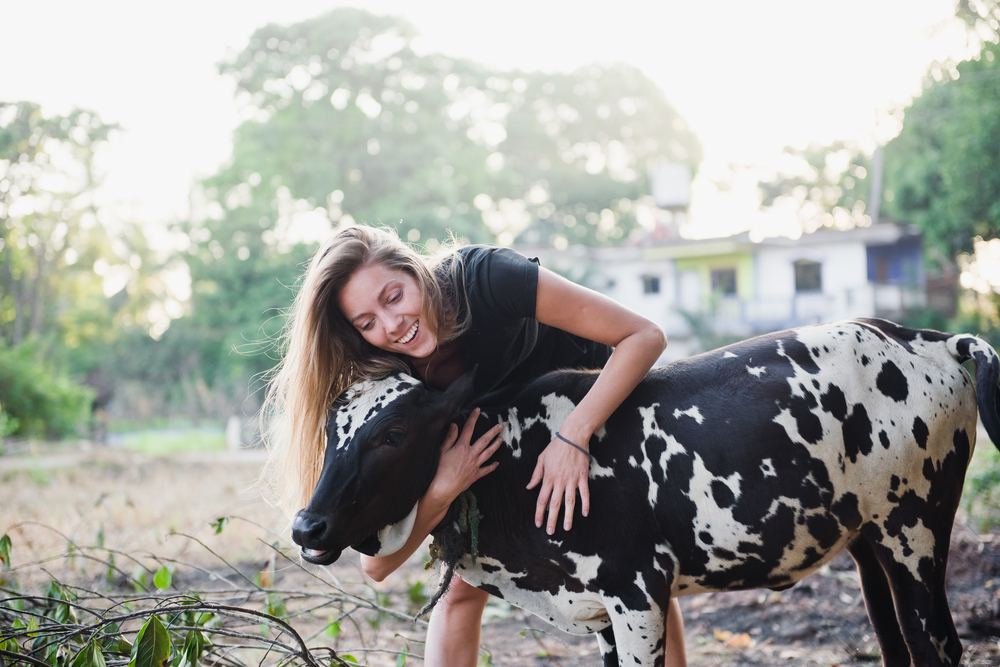

Every now and then, the internet stumbles onto something that sounds completely unhinged and turns out to be not only real but genuinely grounded in science. Cow cuddling stress relief is that thing. Not stress eating. Not stress napping. Not even stress-scrolling through real estate listings you can’t afford. Actual cows, actual cuddling, actual farms in the Dutch countryside – and actual evidence suggesting it works.
The idea that leaning against a 1,400-pound animal in an open field could dissolve the cortisol your body has been stockpiling since last Tuesday sounds like a punchline. It is, in fact, a decades-old practice, a growing global wellness movement, and increasingly the subject of serious behavioral science research. The Dutch have been onto something. As it turns out, they usually are.
A month where even the car ride home feels loud is probably the right time to look at something most people would scroll past. The science and the story behind cow cuddling run deeper than you’d expect.
Where “Koe Knuffelen” Came From
Cow cuddling has its roots in the Netherlands, where it is known as “koe knuffelen.” The practice began as part of a Dutch wellness trend emphasizing the therapeutic benefits of close contact with animals, after Dutch farmers observed the calming effects of interacting with cows and started opening their farms to the public. Most reports agree the practice originated in the early 2000s, and it gained international traction sometime during the COVID-19 pandemic.
The timing of that second wave makes obvious, painful sense. A global lockdown stripped people of casual touch, background noise, and any reason to leave the house. The Gentle Barn in Los Angeles – which has three locations across the country – reported that 600,000 people had hugged cows at their facilities over the years, and staff noticed demand climbing during the pandemic when many people felt lonely in enclosed spaces. When physical proximity to other humans became complicated, people started booking sessions with thousand-pound animals who have no opinion about your vaccination status, your work drama, or the passive-aggressive text you sent your sister.
From those Dutch farms, the practice spread to other parts of Europe and North America, and farms offering cow cuddling can now be found in many countries, each assembling their own version of the experience. Mountain Horse Farm in upstate New York, for instance, charges $300 for a 90-minute cow cuddling session for two people – which tells you something about how seriously the American wellness market has taken this.
What Actually Happens During a Session
Cow cuddling involves spending time with cows in a pastoral setting, engaging in activities like petting, brushing, and cuddling. The idea is to connect with these animals in a quiet, relaxed way that promotes calm and well-being. Most sessions begin with an orientation: a brief introduction to the specific animals, guidance on how to approach them safely, and a pace considerably slower than most people are used to moving at. You don’t rush a cow, and that, somewhat pointedly, is the entire point.
The cows selected for these sessions are typically calm and well-accustomed to human contact. Participants often end up reclining against the cow’s side, resting a head against the animal’s neck or belly, or simply sitting nearby while the cow grazes. Back rubs and the occasional friendly lick become part of the encounter.
There’s something about that forced deceleration – the way the session structurally prevents you from doing anything else – that seems to be doing a large portion of the psychological work even before any hormones get involved. You cannot multitask when there is a cow in front of you. You cannot check your phone, scroll your inbox, or mentally compose tomorrow’s to-do list while an animal the size of a small car is breathing warm air on your shoulder.
The Cow Cuddling Stress Connection: What the Science Says
The case for cow cuddling stress relief is built on the same foundation as the broader science of human-animal interaction, with a few features specific to large animals that make the picture more interesting.
According to PetMD, positive interactions with animals trigger the release of oxytocin, endorphins, and prolactin in humans while stress hormones, including cortisol, go down. Oxytocin is the bonding hormone – the same one your body releases during a long hug or when you hold a newborn. Cortisol is essentially the opposite: your body’s chemical signal for “something is wrong and we need to stay alert,” which is useful when you’re being chased by something large but considerably less useful when you’ve been in a state of low-grade emergency for three consecutive years.
Research shows that being near a companion animal, or actively engaging in animal-assisted interactions, can reduce measurable stress markers, with multiple studies reporting changes in heart rate, heart rate variability, and blood pressure that indicate a more relaxed state after stroking or interacting with animals. The body, in other words, is not neutral about warmth and contact. It responds.
What makes cows specifically compelling is partly their physical size and partly their biology. Dairy cows can have a resting heart rate as low as 48 beats per minute – dramatically slower than that of cats, dogs, and humans. There is research suggesting that being near an organism with a significantly slower resting heart rate may contribute to a calming feedback loop – the nervous system taking cues from its environment, the way it always has, except in this case the environment is basically a living weighted blanket with hooves.
A 2023 exploratory study published in Frontiers in Psychology investigated changes in hormone levels and self-reported anxiety during human-cow interactions, though researchers acknowledged that only 40 percent of measured oxytocin levels fell within the sensitivity range of their assay, indicating that larger sample sizes are needed in follow-up research. The cow-specific research is still early. The foundational science of human-animal interaction is robust; the cow-specific literature is promising but not yet settled. Knowing that is useful if you’re deciding whether to mention it to your doctor or just your friends.
Why Bigger Might Be Better
Equine therapy – the use of horses in structured therapeutic settings – has been building a clinical track record for years. Animal-assisted interventions have been studied for their capacity to reduce symptoms of depression and PTSD, with one study finding that horse riding helped veterans experience positive changes and symptom reduction for up to three months, and shorter-term benefits observed with other animals as well.
The parallel to cow cuddling is more than aesthetic. Both involve large, warm, largely non-reactive animals whose sheer physical presence creates a sense of containment that smaller animals simply can’t replicate. A lap cat is wonderful. A 1,400-pound animal leaning back into you is a categorically different physical experience – one that activates the body’s sense of safety in a way that’s harder to think your way out of.
Cow cuddling is thought to boost positivity and reduce stress by increasing oxytocin, the hormone associated with social bonding. The outdoor farm setting adds another layer that indoor therapy options don’t provide. You’re outside. There’s probably grass. The sky is visible. The cellular signal might be poor. All of this is doing more than you’d give it credit for.
For anyone curious about the broader science connecting animals and emotional well-being, the research on animal-assisted therapy covers territory that’s relevant well beyond the farm.
What a Session Is Actually Like (and How to Find One)
On arrival at a cow cuddling farm, participants typically receive a briefing on the farm’s rules, an introduction to the animals, and guidelines on how to interact with them safely and respectfully. Sessions can range from an hour to a full afternoon, and some farms incorporate other elements – farm tours, hay bales, a cup of something warm – that extend the experience well beyond the cuddling itself. The briefing and the slowness are features, not formalities. They are how the deceleration actually begins.
Ethical considerations matter here. Reputable farms prioritize animal welfare, and the cows used for cuddling are often treated as companions who genuinely enjoy human interaction. An animal that doesn’t want to be there isn’t therapeutic for anyone, including the animal. It’s worth choosing farms that ensure their animals have ample time to rest and engage in natural behaviors.
The cost varies considerably by country and operator. Dutch farms tend to be substantially more affordable than their American counterparts, which have folded cow cuddling into the premium wellness category with corresponding prices. It’s worth searching specifically for farm sanctuaries and animal therapy centers rather than luxury wellness retreats – the cow doesn’t charge extra because the hay is artisanal.
Read More: 12 Reasons Men Blame Women for Their Loneliness Instead of Going to Therapy
The Part That Isn’t Just a Quirky Trend
Cow cuddling stress relief is a window into something most people don’t examine head-on: how starved modern life has become for slow, unconditional physical presence. A viral moment on the internet eventually cycles out. The biological need it points to does not.
A 2024 systematic review published in JMIRx Med concluded that the overall evidence for animal-assisted therapy shows promise as an effective intervention for promoting well-being across diverse populations, while also noting that further research and standardized outcome measures are essential for advancing the field. The science is building. The demand preceded it, the way it usually does.
There’s a reason people are driving to farms outside their cities, lying down next to an animal they’ve never met, and leaving an hour later feeling measurably different. It isn’t magic. It’s biology doing what biology does when the conditions for safety are finally present: it exhales. The cow, resting at 48 beats per minute, has no particular interest in your deadlines. It offers warmth, weight, and the particular silence of something that isn’t waiting for you to perform.
You can get a lot of therapy in a lot of offices. Most of it is good and some of it is necessary. But something specific happens in an open field, leaning against something enormous and completely unconcerned with your problems – a reset the nervous system recognizes even when the mind is skeptical. It turns out that reset has a name in Dutch, and it’s been available for more than twenty years.
Disclaimer: This information is not intended to be a substitute for professional medical advice, diagnosis, or treatment and is for information only. Always seek the advice of your physician or another qualified health provider with any questions about your medical condition and/or current medication. Do not disregard professional medical advice or delay seeking advice or treatment because of something you have read here.
AI Disclaimer: This article was created with the assistance of AI tools and reviewed by a human editor.