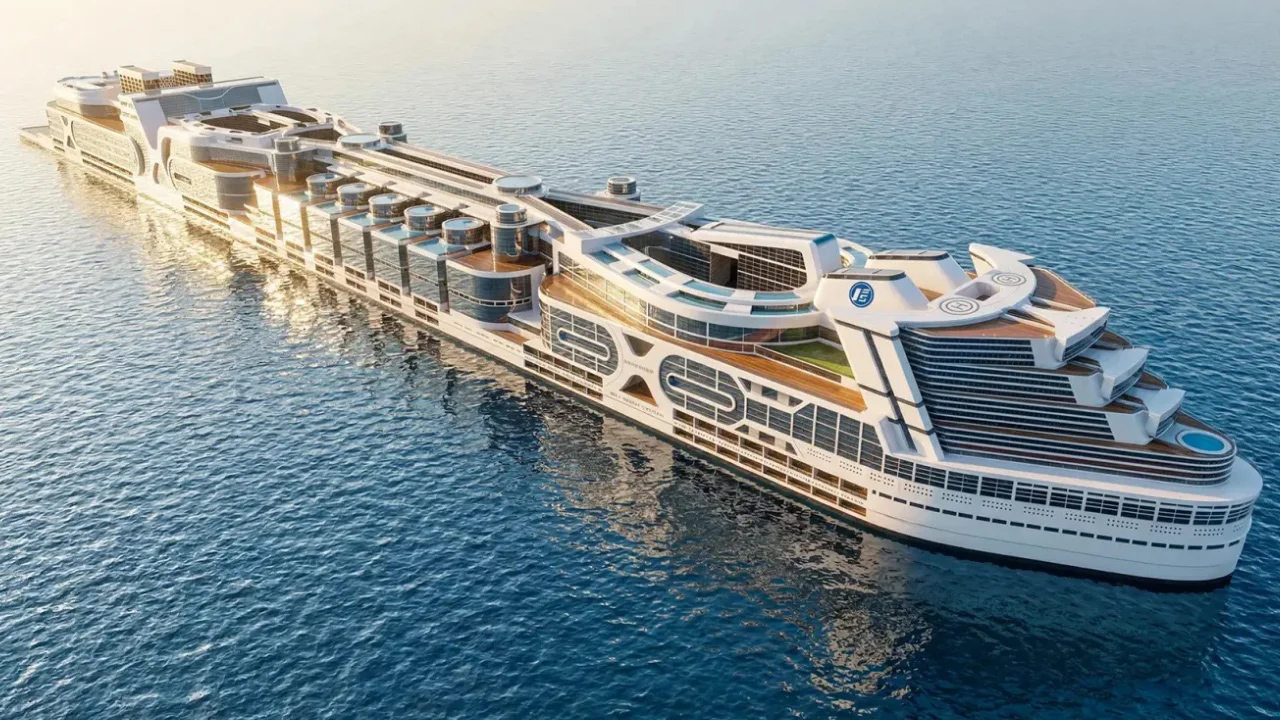

Somewhere between genuine engineering ambition and a very persistent press release lives the Freedom Ship concept, and in June 2026 it is making headlines again, exactly as it has every few years since the late 1990s. The rendering is beautiful: a mile of gleaming white superstructure sliding past a coastal skyline, thirty decks tall, never tied to any port, carrying eighty thousand people around the curve of the earth at a stately seven knots. The concept is a genuinely seductive image, and the people behind it are not, to be clear, running a scam. They are running something more unusual: a dream that has survived three decades, two financial crises, and the death of its original inventor, and still has not managed to get a single steel plate wet.
That longevity is its own kind of story. Most ambitious concepts either get built or quietly disappear. The Freedom Ship concept does neither. It resurfaces, generates a wave of breathless coverage, and then retreats back to the drawing board, where it has been residing, more or less continuously, since 1994. Understanding why requires a close look at what the project actually proposes, what it would cost, and what has stopped it every time before.
The Concept Itself
The Freedom Ship was first proposed in the late 1990s by engineer Norman Nixon, whose name for the project reflected his vision of a mobile ocean colony free from the property, municipal, or federal laws of any nation state. Nixon, based in Sarasota, Florida, drew on his background in aerospace and marine engineering to outline a barge-like structure designed for continuous global circumnavigation, with mobility specifically intended to sidestep national taxes and regulations.
The concept envisions a vessel 5,900 feet – roughly 1.1 miles – long, with homes, hospitals, and schools alongside hotels and commercial space, designed as a self-contained ocean metropolis for up to 80,000 people. To put that in scale: Royal Caribbean’s $2 billion Icon of the Seas, currently the world’s biggest cruise ship, accommodates 7,600 passengers and 2,350 crew members. The Freedom Ship would carry more than ten times that population. If built, the vessel would stretch almost a mile in length, span approximately 800 feet in width, and rise 30 decks above the waterline.
According to the company, the vessel is designed to function as a self-sustaining city at sea rather than a traditional cruise liner. “The Freedom Ship is envisioned as a permanently mobile city at sea, designed for long-term residence rather than short-term travel. It is not a cruise ship and is not defined by destinations or itineraries,” the company stated. “Instead, it is intended to be a stable, self-sufficient urban environment that continuously circumnavigates the globe while supporting everyday life.”
What Life Onboard Would Look Like
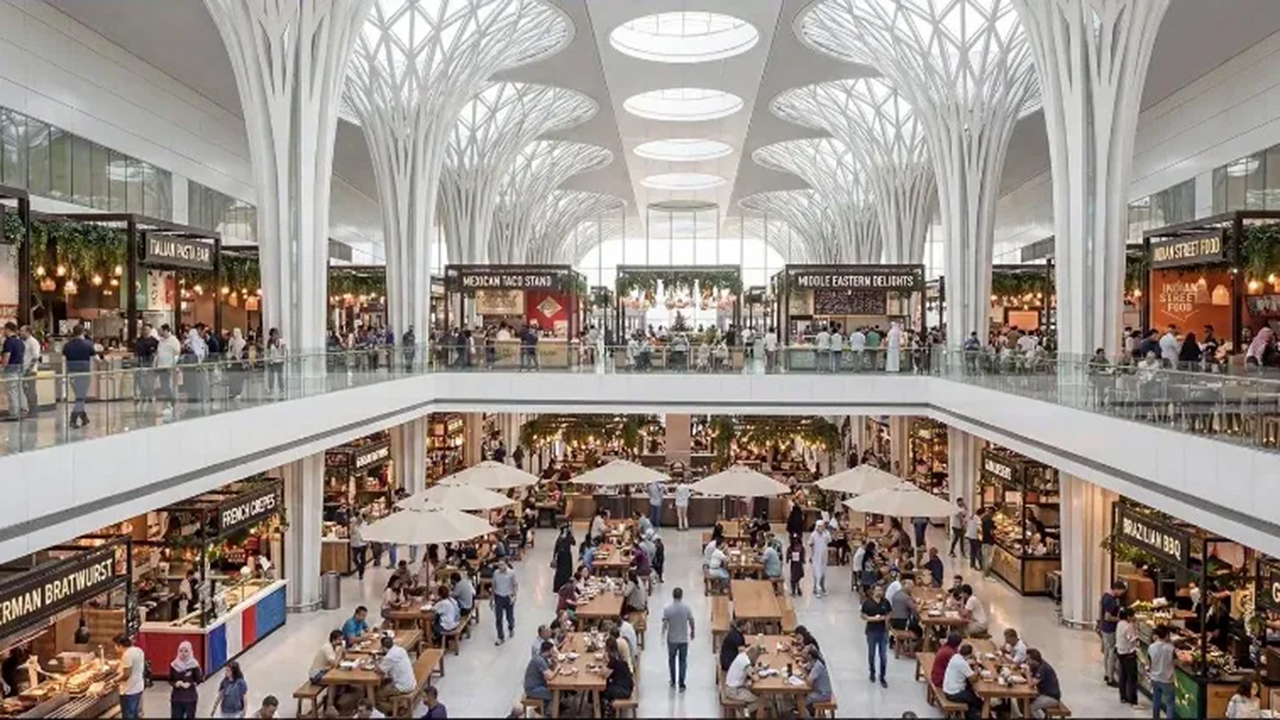
The amenities list reads like a medium-sized city that somehow got misplaced in the ocean. Plans include a 15,000-seat sports stadium, a water park, a diveable aquarium, two museums, a symphony hall, a convention center, nightclubs, a casino, and a full-service spa, alongside three acres of parkland and a two-story eating hall offering a range of cuisines, with green spaces and trails that loop through the area.
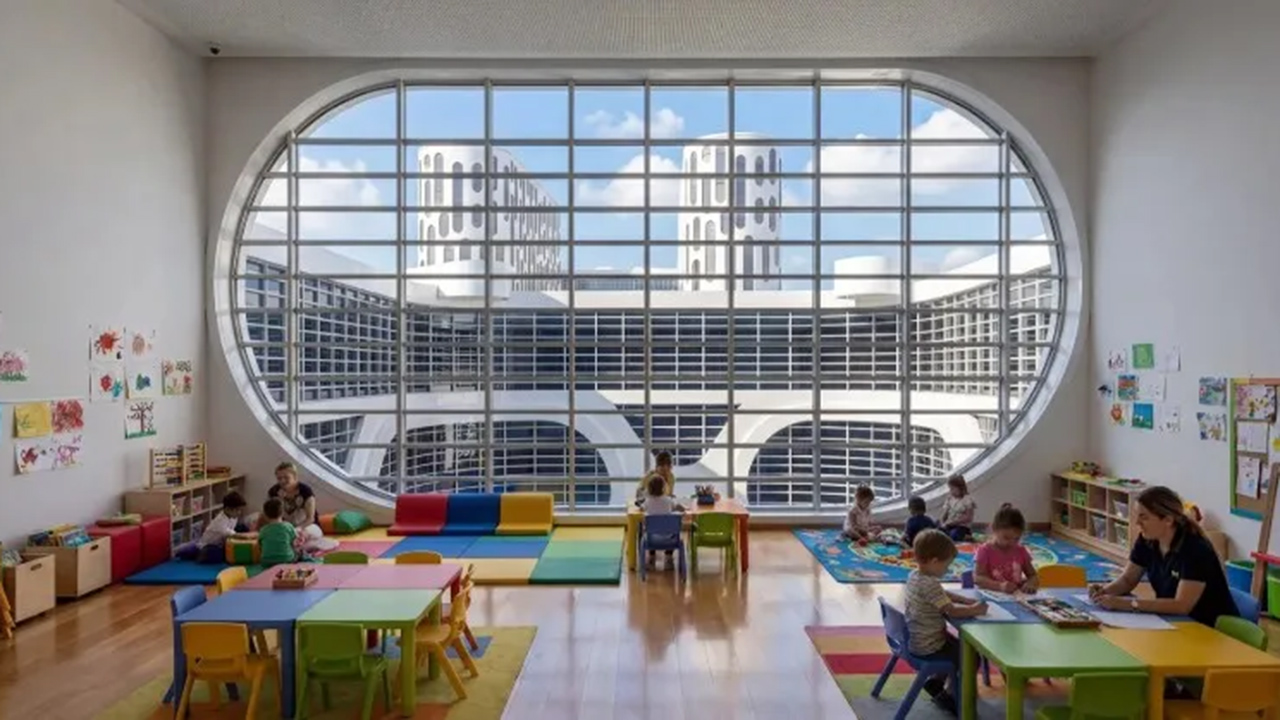
The ship would have homes for 50,000 permanent residents, rooms for 10,000 tourists, and would be managed by 20,000 employees. That last number is easy to glide past: twenty thousand crew members is roughly the population of a small American city, all of whom would be living and working aboard a vessel that, by design, never comes home. There are sections for families, schools that cover early childhood through secondary education, and references to postsecondary education opportunities.
The blueprints describe 17,000 separate living units ranging from 300-square-foot condos to multi-million dollar luxury suites, alongside 10,000 hotel rooms for rotating visitors. So there is a version of residency here for multiple income brackets, not just the wealthy, though the economics of actually buying or renting on a vessel with no land value to anchor pricing would be complicated, to put it gently.
Passengers would travel around the ship via a tram system, while moving to and from land via ferries, with eight helipads also built into the ship. Since the ship would be too massive to dock at a normal port, it would remain in international waters and tour the entire world once every two or three years. The business model for local shore visits, then, is essentially: come to us.
Developers envisage retail, hospitality, and service businesses leasing or purchasing space on board, effectively replicating a land-based commercial district at sea. “We want entrepreneurs to lease or buy space from us, just like they would in a land-based community,” Gooch has said. There is also a more eyebrow-raising pitch buried in the plans. Roger Gooch, CEO of Freedom Cruise Line International, has stated that the ship would feature a fully equipped research hospital and noted that medical research facilities had approached the project because operating outside the reach of regulatory bodies would make the Freedom Ship “an ideal venue for that.” That claim is likely to attract scrutiny, given the complex legal frameworks governing medical research, patient safety, and international maritime jurisdiction.
The Power Question
One of the more significant – and genuinely interesting – aspects of the current proposal is its planned energy source. The vessel is designed to be powered by nuclear fuel, along with several other self-sufficient tools like rainwater collection, solar panels, aeroponics, and wind turbines. Project backers argue that nuclear propulsion would provide sufficient energy for a self-sustaining community while significantly reducing emissions.
However, nuclear-powered civilian vessels remain rare, meaning regulatory approval could become one of the project’s biggest hurdles. The World Nuclear Association notes that as recently as May 2026, the US Maritime Administration was still issuing requests for information on commercially viable nuclear-powered shipping concepts, which gives a sense of exactly how early-stage civilian nuclear maritime propulsion remains as a field. The technology is not impossible – it has existed in military and icebreaker contexts for decades – but applying it to a private floating city designed to loiter off the coasts of dozens of sovereign nations introduces a layer of regulatory complexity that no press tour can smooth over.
The History of Almost
The idea originated with Norman Nixon, a Sarasota engineer who began promoting a floating city in the late 1990s under the banner of Freedom Ship International. The early sales pitch was practically a carbon copy of today’s. By 1999 the company put the price near six billion dollars and claimed several hundred buyers had reserved condominiums averaging eight hundred thousand dollars apiece.
Discovery’s “Engineering the Impossible” gave the concept a glossy television showcase. Sailing dates were announced, then quietly drifted past. By 2002 the estimate had climbed to eleven billion. Mid-decade promotional material boasted of thousands of reservations and a launch as early as 2010, even as the company conceded it accepted no deposits or advance payments. The 2008 financial crisis froze whatever momentum remained, and a press release that year admitted the difficulty of lining up reliable financing.
Following Nixon’s death in 2012, his former partners revived the plan at a reported ten billion dollars, again without breaking ground, and in 2016 the venture briefly attached itself to a marine firm in India. Freedom Cruise Line International was incorporated in Florida in 2018. The 2026 version carries a price tag of roughly sixteen billion dollars. The number that keeps rising is the budget. The number that has never moved off zero is the steel in the water.
The current face of the project is Roger Gooch, CEO of Freedom Cruise Line International. He has told Newsweek that a primary construction location has been identified in Indonesia, and that the team now includes architect Kevin Schopfer and project manager Sridev Mookerjea. Mookerjea, of the Singapore-based Blossom Group, told the outlet, “I believe that with Roger’s efforts, patience and desire to make this a success, the sky’s the limit.” The phrase “sky’s the limit” aboard a ship that has never left the drawing board is, admittedly, a choice.
For a sense of how this fits into a life’s work on living at sea, the story of a retired teacher who chose to live permanently on a cruise ship rather than pay California rent offers a grounded perspective on what ocean living actually looks like when it does exist.
The Engineering Problem Nobody Has Solved
The Freedom Ship’s most fundamental obstacle is not money, though money is the obstacle everyone talks about. It is physics. The reason supertankers are not simply scaled up is that long hulls flex under their own weight as waves lift the bow and stern – a stress called hogging and sagging – that can tear a hull apart. The Freedom Ship’s answer is to bolt together many barge-like sections rather than build one rigid hull, an approach that remains unproven at a mile in length.
Standard shipbuilding techniques cannot easily handle a hull of this size due to the intense structural stress caused by ocean waves, meaning a shipyard would essentially have to invent an entirely new way to build a ship. That is probably the biggest obstacle to the entire project right now. Questions also remain over nuclear licensing requirements, environmental approvals, insurance considerations, and whether a shipyard exists with the capability to construct a vessel of such extraordinary size.
According to its developers, the project would be built in stages, with construction beginning in Indonesia once funding is secured. The hull would be manufactured in sections before being assembled offshore, a process that reflects both the scale and complexity of the design. Assembling a mile-long structure from modular barge sections in open water is a different engineering problem than assembling one in a drydock, and no drydock currently exists that could accommodate the complete vessel in any case.
Why It Keeps Coming Back
The fairer description of the Freedom Ship is not fraud but perpetual motion of a different sort: a sincere and stubborn concept that generates a fresh wave of headlines every few years and then settles back onto the drawing board. The appeal of the idea is real. For a certain kind of person, the notion of buying into a community that answers to no single government, pays no local taxes, and wakes up off a different coastline every few weeks is not a fantasy. It is a considered lifestyle preference. Because the ship is designed to remain permanently offshore in international waters, developers pitch it as a community entirely free from local property taxes, real estate taxes, sales taxes, and import duties.
The floating city concept has predecessors that go back further than Norman Nixon. In the 1950s, Buckminster Fuller proposed floating cities approximately a mile wide that could accommodate up to 50,000 permanent inhabitants, explaining in a television interview with Mike Wallace that such structures would free up land needed for agriculture and industrial uses. The dream, in other words, predates the internet. It may well outlast the current version of the pitch.
The Ship That Belongs Everywhere and Nowhere
Despite repeated revivals over the years, the Freedom Ship remains firmly in the conceptual phase, with no confirmed construction timeline or funding structure capable of supporting a project of this scale. Its latest re-emergence reflects continuing interest in extreme-scale engineering ideas that challenge traditional boundaries between city, vessel, and infrastructure. Whether it progresses beyond the design stage will likely depend not only on financing and engineering feasibility, but also on whether global regulatory systems can adapt to a floating city that, by design, belongs everywhere and nowhere at once.
That last phrase is the real tension in the Freedom Ship concept, and it runs deeper than engineering. A city that belongs to no nation and answers to no local law sounds freeing until you start asking who adjudicates a dispute between neighbors, what happens when someone needs emergency medical care that exceeds the onboard hospital’s capacity, or how twenty thousand crew members exercise labor rights in international waters. The concept sketches a lifestyle and waves past the governance. None of that means it will never be built. The rendering is beautiful, the hunger for the idea is clearly real, and maritime engineering has surprised people before. But the Freedom Ship concept has now spent thirty years being described as approximately four years away from completion, and the gap between a glossy press tour and a steel hull in the water has not closed. What has changed in 2026 is that Gooch has a team, an architect, and a named construction country. What has not changed is the line he has been saying, in nearly identical words, since the project was revived: confident they can do it, but capitalization is key. The dream is floating. The ship is not.
AI Disclaimer: This article was created with the assistance of AI tools and reviewed by a human editor.