

Planes have always carried a particular kind of dread: the lost luggage, the middle seat, the three-hour delay that turns a connection into a missed wedding. People are now being arrested in departure terminals, at check-in counters, on jet bridges, in the middle of ordinary domestic travel, not because they did something suspicious at the airport, but because a federal agency already knew they were coming and was waiting for them.
A woman was stopped on her way to Texas for her father’s funeral. Another was detained on a jet bridge at Denver International Airport as she tried to board a Southwest Airlines flight. These are not border crossings. These are domestic flights – Dallas to Chicago, connecting flights home from family visits – that ended in federal detention.
Immigration attorneys across the country are telling their clients to reconsider boarding a plane. Some are describing it as the most significant shift in domestic immigration enforcement they have seen in decades.
How the TSA-ICE Partnership Became What It Is Now

TSA and ICE have long worked together on federal criminal offenses like drug smuggling and human trafficking. Civil immigration violations, the kind that don’t involve criminal charges, were not part of the arrangement.
In May 2025, TSA and ICE signed a formal agreement to boost information sharing between the agencies, according to a memo disclosed by the nonpartisan watchdog group American Oversight. American Oversight obtained and released the 16-page memorandum of agreement after filing a Freedom of Information Act lawsuit. The agreement establishes rules governing how TSA and ICE may exchange, retain, and use passenger information within the Department of Homeland Security.
A few times each week, TSA sends ICE lists of people flying through US airports. Those lists include names, photos, and other identifying details. ICE checks these lists against its own records. If ICE finds someone they want to target, they can send officers to arrest that person at the airport.
TSA has been sharing more information about noncitizen travelers with ICE, including immigrants who lack criminal records but are suspected of civil immigration violations, like overstaying their visas.
What Happens at the Airport

Plain-clothes ICE agents are increasingly targeting foreign travelers who have overstayed US visas, confronting them at check-in counters and arrival gates. There is no warrant served at the front door, no formal visit to a home or workplace. The enforcement happens where the data says the person will be, at a specific time, standing in a specific line.
A woman was detained at a Washington, DC-area airport on her way home to Texas for her father’s funeral, according to Joe Moravec, an immigration attorney representing her. The woman, who asked not to be identified, had entered the US legally and was in the asylum process. She is now being held in Virginia. Separately, a woman traveling home was arrested on a jet bridge at Denver International Airport as she tried to board a Southwest Airlines flight on July 20, with video of the encounter circulating widely.
The arrests have occurred across the country in at least nine states, from California to Virginia. Enforcement actions have been recorded in at least 15 airports in recent weeks.
Who Is Being Targeted
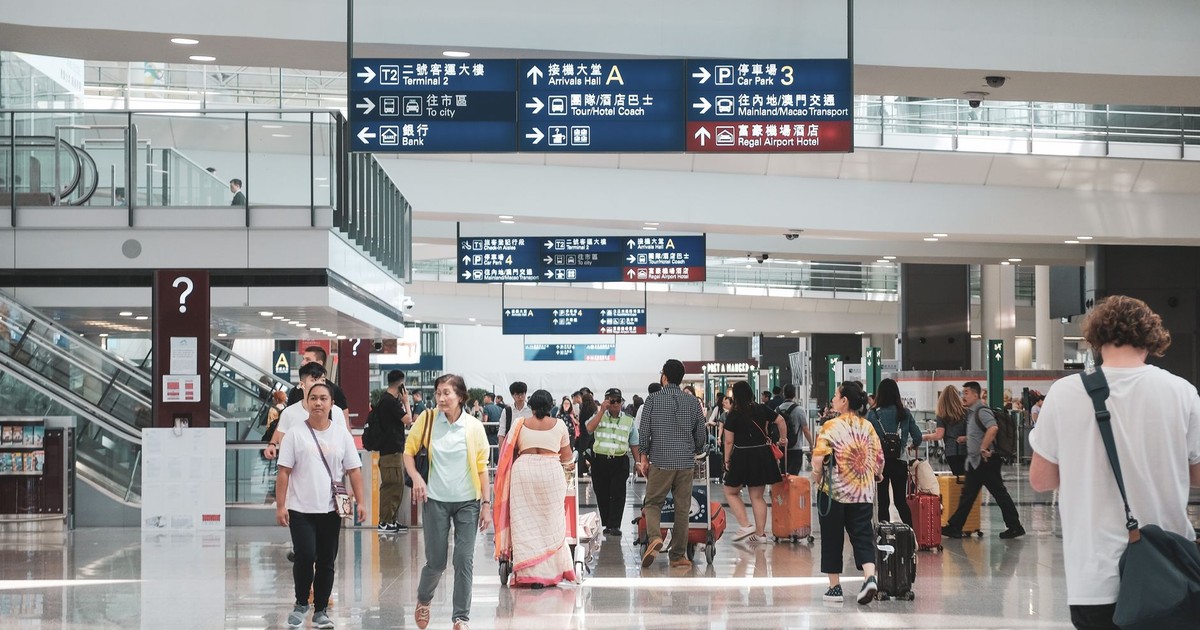
The administration’s public framing has focused on visa overstays, people who entered the US legally and remained beyond their authorized period. But the people actually being detained tell a more complicated story.
The arrests have targeted spouses of Americans, tech workers, asylum applicants, and others with pending green card applications, many of whom entered the country legally and held valid work permits.
ICE activity at airports currently includes identity verification, immigration database review, and detention of individuals with an expired visa stamp, despite pending immigration matters, outstanding removal orders, or perceived status violations. Such arrests and detentions have occurred even where individuals have pending applications for immigration benefits, including requests for asylum, lawful permanent residence, or other forms of permanent protection.
A pending application does not carry the same protection as an approved one. ICE is exploiting that gray area as an opportunity to arrest and detain travelers.
DACA holders have also been among those detained under the current enforcement approach. The sharp drop in international visitors, with tourists canceling US trips in growing numbers, is a reasonable response to a genuinely changed environment.
The Numbers Behind the Push

Internal ICE figures reviewed by Reuters showed that the agency arrested more than 800 people using TSA-generated leads between the beginning of Trump’s second term and February 2026. Those leads were drawn from records involving more than 31,000 travelers.
Department of Homeland Security data show ICE arrested 43,138 people in June 2026, the highest monthly total since President Donald Trump returned to office.
One ICE source described people traveling at airports as “easy targets” who immigration agents can arrest in secured locations while having information about their cases in advance. Airports offer something that neighborhood enforcement operations often can’t: a controlled environment, confirmed identities, and advance knowledge of exactly who will be where and when. The White House has been pressuring ICE to record 2,000 daily arrests.
What Immigration Lawyers Are Telling Clients

Jeff Joseph, president of the American Immigration Lawyers Association, told CNN that enforcement at airports at this level is something the country has never seen, and that the cooperation between TSA and ICE is equally unprecedented.
Shannon Shepherd, vice chair of the American Immigration Lawyers Association’s Chicago chapter, said she now advises clients with pending immigration cases to avoid domestic air travel entirely.
Normally, government agencies have rules about sharing private information, but TSA and ICE are both part of the same department, the Department of Homeland Security, so those inter-agency privacy rules do not apply in this context.
Attorney Jazmin Preciado of Centro Legal de la Raza in Oakland said that during this period, if someone does not have an urgent reason to travel, even domestically, they should weigh whether the risks are worth it.
The Government’s Position
The Department of Homeland Security framed the policy shift as a reversal of what it called a “horrendous Biden-era policy” that allowed people in the country illegally to fly domestically. The department stated that the administration is working to ensure that people in the country illegally can no longer fly unless it is out of the country to self-deport.
In March 2026, during a government shutdown, the Trump administration deployed ICE agents to more than a dozen airports to fill TSA staffing gaps, which created the infrastructure for the current enforcement operations.
Customs and Border Protection data shows that approximately 1% of non-immigrant visitors overstayed their visas, representing 482,954 people. That is the population the government says it is targeting. The cases that have drawn the most public attention, the asylum applicants, the people with pending green card applications, the spouses of US citizens, are a different story from that framing.
What This Means Going Forward
The formal memorandum of agreement between TSA and ICE did not create the enforcement actions that have made the news. Those actions represent an expansion of a practice that began taking shape in late 2025 and has intensified significantly through 2026. The memo simply documented what was already happening, and its disclosure through a Freedom of Information Act lawsuit is what brought the scale of the arrangement into public view.
For millions of people, that changes what a domestic flight means. For anyone whose immigration status is pending, expired, or in any gray area, the act of booking a ticket now carries a different calculation than it did two years ago. Immigration attorneys are trying to help clients understand those risks on a case-by-case basis, but the honest answer is that the rules are still being written in real time, through the enforcement actions themselves, through legal challenges, and through disclosure requests that continue to surface new information about how the program actually works.
Immigration attorney Charles Kuck, who has practiced for 38 years, told reporters he had never seen enforcement like this before.
Disclaimer: This information is not intended to be a substitute for professional medical advice, diagnosis, or treatment and is for information only. Always seek the advice of your physician or another qualified health provider with any questions about your medical condition and/or current medication. Do not disregard professional medical advice or delay seeking advice or treatment because of something you have read here.
AI Disclaimer: This article was created with the assistance of AI tools and reviewed by a human editor.