

I’m sure no adult just wakes up one morning and decides to write off their parents. Anyone who has made that decision probably knows how hard it was to make. But research consistently shows that a sizeable share of adult children will become estranged from a parent at some point. It tends to happen more often with fathers than mothers, usually by the time the child reaches their mid-20s. The problem is that most parents say they had no idea it was coming. Their children say the signs were there for years. That disconnect is what makes resolution so hard, because one side can’t see what the other has been living with. If you’re going through this or know someone who is, here are 16 of the most common reasons adult children stop visiting their parents.
Every Visit Feels Like a Performance Review
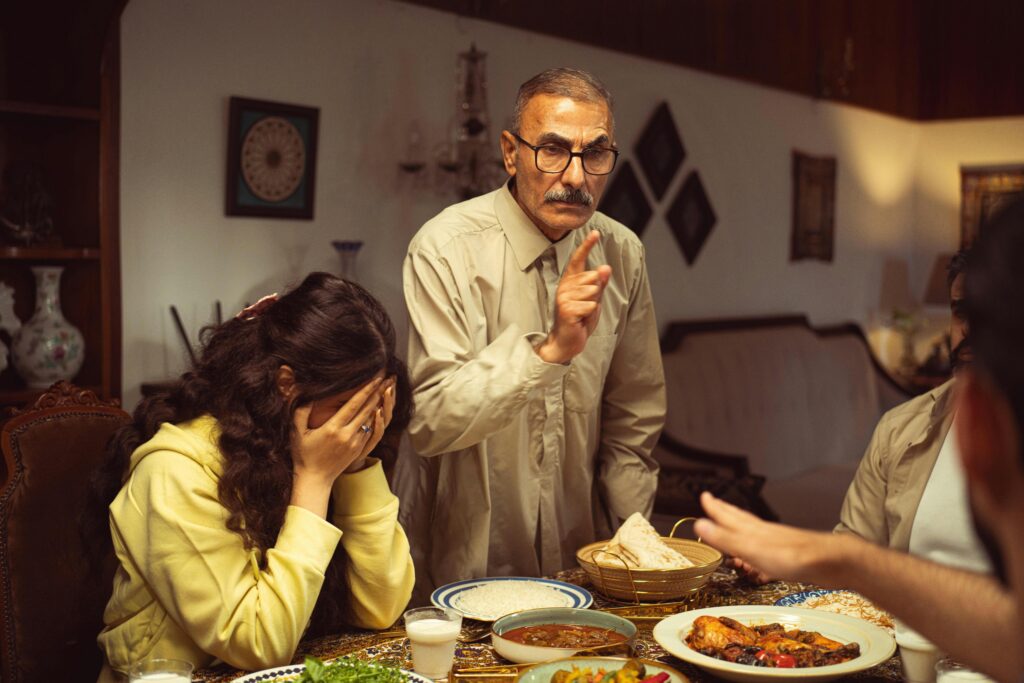
Joshua Coleman, a psychologist who has spent decades counseling estranged families, sees one complaint come up more than any other. Adult children say every visit home turns into an evaluation. Their parents comment on their weight, their career, their parenting, and their partner, and frame all of it as concern. But what the adult child hears is a running list of everything they’re doing wrong. Coleman wrote about this in a 2021 Atlantic essay, arguing that most parents genuinely believe they’re being helpful. That belief is what makes the problem so resistant to change. The child keeps showing up, hoping it will be different this time, until one day they just stop.
Guilt as a Strategy Backfires

Some parents don’t ask their children to visit; they make their children feel bad for not visiting. Using phrases like “I won’t be around forever,” or “other people’s children visit every week,” or “I guess I’ll just sit here alone then.” These phrases try to pull the child closer through obligation, but they do the opposite. The child starts linking visits with emotional pressure instead of connection, and that feeling builds the more it happens. Guilt tripping may work once or twice, but over time, it rewires how the child feels about the relationship itself. Something that should feel like home starts feeling like a debt they can never pay off.
Boundaries Get Ignored

When a child becomes an adult, some parents struggle to make that adjustment. They still see themselves as the authority. They treat their adult child’s boundaries the way they would have treated a teenager’s pushback, as something to override. The adult child asks them to stop commenting on their marriage, to call before showing up, and to stop discussing their salary with relatives. The parent dismisses the request or treats it as an overreaction, and sometimes they comply for a week before going right back. Eventually, the adult child learns that no matter how clearly they communicate a limit, it won’t matter. The only boundary the parent honors is the one they can’t talk their way around.
Money Comes With Strings Attached

Money is a source of stress in most of our lives. Adult children who have parents willing to help carry some of that weight sometimes find that the help comes with conditions. A parent offers to cover a down payment or help with a big expense, and from their side, it feels like love, like they’re still doing their job. But when the parent uses it to justify opinions about how the child should live, or brings it up during arguments, the gift stops feeling like a gift. It starts feeling like a contract the child never agreed to.
The Relationship Is Frozen in Time

Imagine being 40 with a mortgage, a career, and kids of your own, but the moment you walk through your parents’ door, they treat you like you’re 14 again. That’s what many estranged adult children say they’ve gone through. The parent dismisses their opinions, talks over their experience, and never really makes the shift from authority figure to something closer to a peer. Outside of the family home, these children have friendships built on curiosity and mutual respect, where people take their thoughts seriously and treat their independence as a given. And every visit home reminds them of what that contrast actually feels like.
The Child Becomes the Parents’ Therapist

Some parents treat their adult children as their primary emotional outlet. Psychologists call this emotional parentification, a role reversal where the child becomes the parent’s therapist and confidant. For many of these children, this started long before adulthood. But as adults, it becomes harder to sustain because they now have their own problems. Some parents believe their children owe them this support, that after everything they sacrificed, the least the child can do is be there. But parenting is a one-way street, and children should not have to carry what their parents carry.
Childhood Trauma Nobody Talks About

Image by: Unsplash
In a 2015 study, Kristen Carr and colleagues surveyed 898 estranged parents and adult children. They found that adult children commonly felt their parents never acknowledged or validated the harm their behavior caused. But parents who heard this kind of feedback often felt hurt. They believed their child had forgotten the good parts of their childhood in favor of a version where it was entirely negative. Guilt usually drives that denial, because it’s easier to believe they tried their best than to accept that their best still caused harm. And when the child realizes that acknowledgment is never coming, they’re left with a choice. Keep pretending their own memory is wrong, or stop keeping the peace.
“I Did My Best” Isn’t an Apology

Parents in denial also tend to default to the same kind of language when confronted, saying things like “I did my best,” or “that never happened,” or “you’re remembering it wrong.” Each one tells the child, again, that what they went through isn’t valid. Coleman, the psychologist we referenced earlier, points out that vague apologies almost never work because they don’t name the specific harm. A parent saying “I’m sorry I wasn’t there enough” carries more emotional intent behind it than “I’m sorry you feel that way.” The first one names the failure. The second one puts the problem back on the child.
The Parent Won’t Get Help

Someone in denial can’t always see the harm in what they’ve done. And if they believe they did nothing wrong, then therapy feels like an admission that they did. That kind of admission threatens everything they’ve built their identity as a parent around. Coleman has said that taking responsibility is almost always a necessary step toward reconciliation. But many parents hear “take responsibility” and interpret it as “accept that you were a bad parent,” which isn’t the same thing. What most adult children actually want is for their parents to acknowledge what happened, apologize for the specific harm, and then do something differently going forward.
The Parent Who Provided Everything Except Emotional Connection

Parenting comes with sacrifices. Long working hours to make sure the family doesn’t go without, covering braces, summer camp, and college, and still showing up to every game and recital on top of it. But a parent can do all of that and never learn how to connect emotionally with their child. They can attend every game and never ask how the loss felt. They can sit through every recital and never have a real conversation about what their child is going through. When that’s all a child knows, it becomes the foundation of the relationship. And by the time they’re an adult, there isn’t much of a bond holding anything together.
Favoritism Among Siblings

All of us with siblings have probably thought once or twice that our parents like our siblings more. Unfortunately, you might have thought right. Karl Pillemer, a sociologist and professor of human development at Cornell University, found that roughly 66% to 75% of mothers actually do prefer one child over another. It tends to show up in things like tone of voice, who the parent believes first in an argument, or whose life choices they question while celebrating another’s. Children report noticing these differences from a young age, and what makes them so damaging is that they accumulate. A single moment is easy to brush off, but a lifetime of them can quietly erode even the closest family relationships.
The Parent Won’t Accept Who the Child Has Become

A child’s sexual orientation, gender identity, career, or way of living can all become points of rejection when a parent can’t accept who their child has grown into. Visits turn into a performance of concealment. The child either hides the truth, which is exhausting, or shares it and faces disapproval, which is worse. Over time, the message they absorb is clear. Come home, but don’t bring your real self with you. And eventually that trade-off stops being one they’re willing to make. No amount of family loyalty is worth pretending to be someone you’re not every time you walk through the door.
Values That No Longer Overlap

When a parent and adult child hold opposing values, every interaction becomes a lose-lose. The child either pushes back and starts a fight that goes nowhere, or stays quiet and feels like they’ve betrayed their own beliefs. These disagreements have always existed between generations, but they’ve grown in recent years. Pillemer’s research has identified clashing values as a driver of mother-child estrangement. The parent thinks the child abandoned the values they were raised with, and the child thinks the parent refused to grow.
Divorce Reshapes Everything

Some divorces pull a family apart. Children end up in loyalty splits, and family time turns into a scheduling problem where one parent is around far less than the other. A nationally representative study led by Rin Reczek, a sociologist at Ohio State University, surveyed over 16,000 parents. They found that 26% of adult children reported a period of estrangement from their father, compared to just 6% from their mother. The non-custodial parent isn’t there for the ordinary moments that grow a relationship, and over time, that absence becomes the norm.
The Child’s Partner Becomes a Flashpoint

When a parent rejects the person their child loves, the child reads that as a rejection of their own judgment and their own life. Many parents believe the partner is the one driving a wedge between them, but children almost never point to their partner as the reason for pulling away. And that’s the thing that keeps this cycle going. A parent who believes the problem is someone else’s influence has no reason to look at their own behavior. And a child who feels the parent is unfairly judging their partner has no reason to keep putting them in that position.
The Child Is Struggling With Their Own Mental Health

Mental health struggles don’t always look like mental health struggles. Someone dealing with depression or anxiety can seem fine while quietly falling apart. And when the signs are that easy to miss, a parent can mistake withdrawal for coldness or silence for disinterest. The child, meanwhile, is often the last to say anything, because the fear of disappointing a parent runs deeper than it does with almost anyone else. So the child pulls back, the parent fills the silence with their own explanation, and the distance grows without either side understanding what’s actually happening.
Read More: 20+ Kids Who Are Carbon Copies of Their Parents
The Breaking Point

Estrangement is what happens when a child decides the emotional cost of staying outweighs the benefit of keeping the relationship. It rarely comes from one event. It usually builds over years of feeling dismissed, controlled, or unseen in ways nobody ever acknowledged. What makes it permanent isn’t the original harm but the absence of repair afterward. Once a child stops believing the relationship can change, they stop trying. The withdrawal that follows isn’t punishment or stubbornness but the quiet end of something they’ve already grieved. By the time the distance becomes visible to everyone else, the pain is already behind them.
What Can Be Done

If you’re the one who caused the hurt, start by asking what they experienced without correcting their version of it. Not “that’s not what happened,” just “tell me what it was like for you,” and then sitting with the answer. Most people skip that because it means accepting a version of yourself you didn’t intend to be. But it’s the only thing that signals the conversation has actually changed. If you’re the one who left, going back doesn’t have to mean Sunday dinners and pretending everything is fine. It can start with one honest phone call where both of you agree that the old version of the relationship is gone. Whatever comes next starts on different terms. It only works if both people stop protecting the story they told themselves and start telling the truth instead.
Read More: When Love Isn’t Enough: 11 Childhood Expectations That Can Wound Devoted Parents