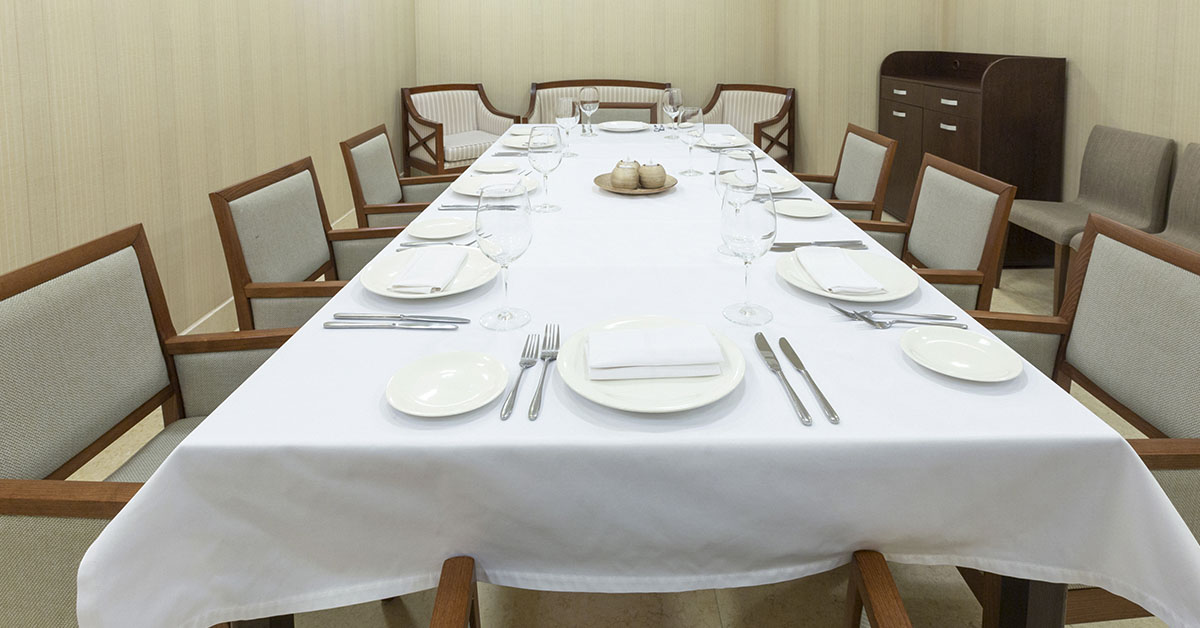

Does where you sit at the table actually mean anything, or are we reading too much into a small choice? Some see it as a pure accident. Others think the seat we pick shows how we relate to the people around us.
Mid-century psychologists took the second view and spent years watching people pick seats in cafeterias, jury rooms, and discussion groups. They wanted to understand how physical space shapes the way we behave in a group. They found that seat choice is rarely random. The spot we choose points to how we like to connect. We might lean toward leading, challenging, listening, supporting, or watching.

Five seat choices come up again and again at dinners, meetings, and family gatherings. Each one points to a different way of relating to the room. The choices are the head of the table, directly across, the corner, side by side, or the far end. Once you know what each seat says, the next dinner or meeting starts to make a lot more sense. You can see who is positioning themselves to lead, and who wants to push back. You can also see who is happy to sit back and watch it all play out.
The Head Seat, The Commander
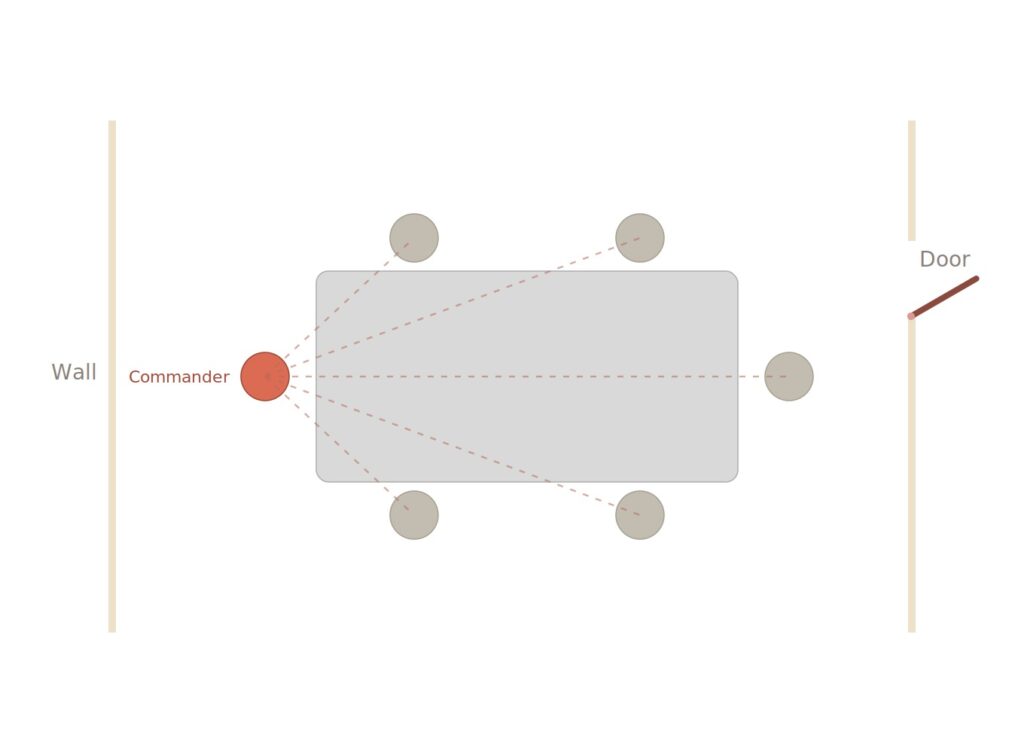
In 1961, Fred Strodtbeck and L. Harmon Hook ran mock juries in Chicago. They sat strangers at a rectangular table with a head seat at each end and five chairs down each side. Then they asked the group to elect a foreman and watched them work through a case. The jurors who took the head seats were elected foremen. They spoke more during deliberations, and fellow jurors rated them as having contributed the most. The chair was doing the signaling before anyone had said a word.
The pull Strodtbeck caught does not only show up when the stakes are formal. This instinct is to the seat itself, not the occasion. Whoever is drawn to the head of a jury table is drawn to the head of every table. At a jury, it looks like leading the verdict, and at a dinner, it looks like leading the logistics. But it is the same person choosing the same chair. Watch any group sit down at a long table, and the head seats fill first. Someone walks in already knowing where they are going, and the rest of the room reorganizes around them. Whoever can see every face at once runs the conversation by default.
Call them commanders. They take the chair facing the room in a restaurant. In a meeting, they sit where the projector points, and at Thanksgiving, they end up where the carving knife is. The seat is the instinct, and what follows it is effort. Once they can see the whole room, they cannot help running it. They are usually the type who sends the calendar invite and coaches the kids’ team. They chair the parent association and run the group chat for the weekend away. Their hobbies tend to carry the same shape. That might be captaining a Sunday league side, or running a book club where they pick most of the books. They think in tasks, and the relationships grow around the tasks. That can feel efficient from the inside, and sometimes one-sided from the outside.
People around a commander often find this steadying for a long time. Someone is always handling the logistics, and the plans rarely fall through. But that is what a commander tends to offer in place of slower attention. When the group says yes to the restaurant pick and turns up on time, the commander can read that as closeness. It is really just compliance. Agreeing to a plan is not the same as feeling known. The people who sit near a commander for years sometimes realize, late, that they were consulted on logistics. They were never really asked what they wanted or how they felt.
Directly Across, The Challenger
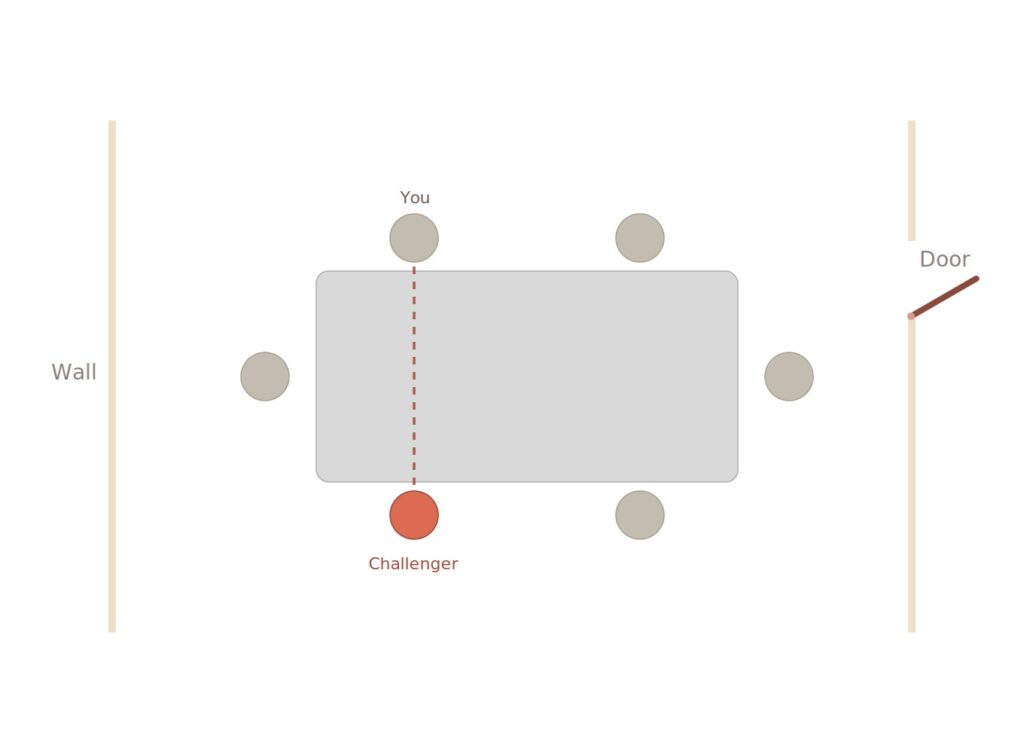
A challenger at a dinner locks onto the person across from them and eats while watching that person’s face. They interrupt sometimes, not rudely, because your sentence has already pulled a reply out of them. They ask what you meant by a word. And they push back on something you said, as if you had said it seriously. By the end of the meal, you feel either seen or slightly interrogated, often both.
That face-to-face instinct has a research history behind it. Robert Sommer, a Canadian environmental psychologist at UC Davis, ran seating experiments through the 1960s. He gave students a rectangular table and asked where they would sit for different tasks. Those tasks included cooperating on shared work, having a casual chat, or competing. Competing pairs sat face-to-face almost every time. Sommer argued that people pick the facing seat when they want to engage someone as a separate presence. That is how a challenger likes to relate to the person they are interested in.
Bernard Steinzor, an American clinical psychologist, had caught the same thing earlier from a different angle. In 1950, he watched small groups talk in circular arrangements and tracked who spoke after whom. He found that people are most likely to respond to whoever sits across from them at close range. They were least likely to respond to whoever sat alongside them. Later researchers named this the Steinzor effect. The person facing you at conversational distance gets the most replies. Face-to-face seating tends to pull more response, and often more friction.
You see this on a first date. A challenger studies your face through the whole meal and pulls at the threads of what you say. They end up knowing more about you than you meant to give. At work, challengers tend to land in law, sales, or journalism, anywhere the job rewards asking one more question. Their hobbies lean toward structured competition with a clear opponent, so tennis over jogging. They are not looking for a fight; they are looking for an exchange. And they find quiet cooperation a little flat. Friction, for a challenger, is a form of closeness.
That is the thing both the challenger and the people around them often miss. People who equate closeness with agreement read this as hostile, even when it is the closest attention in the room. So if a challenger stops pushing back on your ideas, you have a problem. They have stopped caring what you think. Sitting across from someone is not a wall. It is an invitation to talk.
The Corner Seat, The Connector
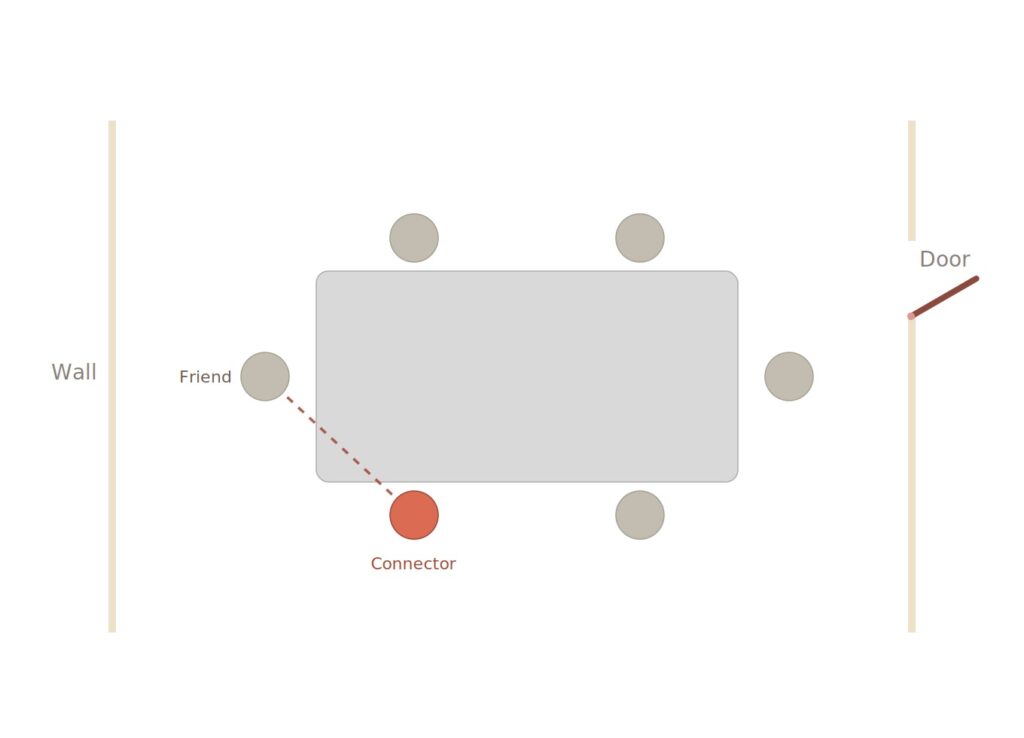
At a noisy dinner, someone quietly suggests moving to the corner of the couch. In a family, the teenager wants a real conversation in the kitchen while everyone else watches the game. In an office, the colleague hears a hard topic come up in a big meeting. They message you afterward to grab coffee. The conversation you both need is a two-person one, not a twelve-person one.
These are connectors, and the seat they prize is the corner, one chair around from the head. They turn toward whoever sits there, with knees almost touching and the table’s edge between them. What they want is the angle itself. Two people sitting at a corner can turn toward each other in a way no other arrangement allows. Eye contact at that angle feels chosen rather than forced. You can look at the other person when you want to, and look at the salt when you need a second. The corner also lets two people share a view of a menu, a phone, or a photo. There is no table between them, and no neck-craning of sitting shoulder to shoulder.
Sommer’s earlier work pointed here before the competition studies did. He published Studies in Personal Space in the journal Sociometry in 1959. The work was drawn from months of watching strangers and acquaintances pick seats in a hospital cafeteria. He followed it by asking people to rate different layouts against different activities. The corner came out on top for real conversation.
Connectors get called when things are hard. The friend in crisis ends up at a small round table with a connector, angled in. So does the sibling in a bad patch, and the parent worried about their kid. They talk for two hours. The other seat types would have moved past it in 15 minutes. They do not rush this, and their sentences run longer and more winding. They think while they talk, and leave room for the other person to do the same. That slower tempo is what the people around them come to rely on.
At work, connectors land in therapy, teaching, nursing, coaching, and small-group facilitation. The job asks you to sit with someone and work something out slowly. Their hobbies follow the same shape. They favor long walks with one friend, book swaps, pottery classes, and dinners that stretch past midnight. The pull is toward anything where a real conversation can happen inside the activity.
Connectors pay a price for that depth, and the price is width. They skip the group settings where wider networks form, while commanders and challengers pick up acquaintances without thinking about it. The trade works for decades, until a connector wakes up at 50 with only three people who truly know them.
Side by Side, The Ally
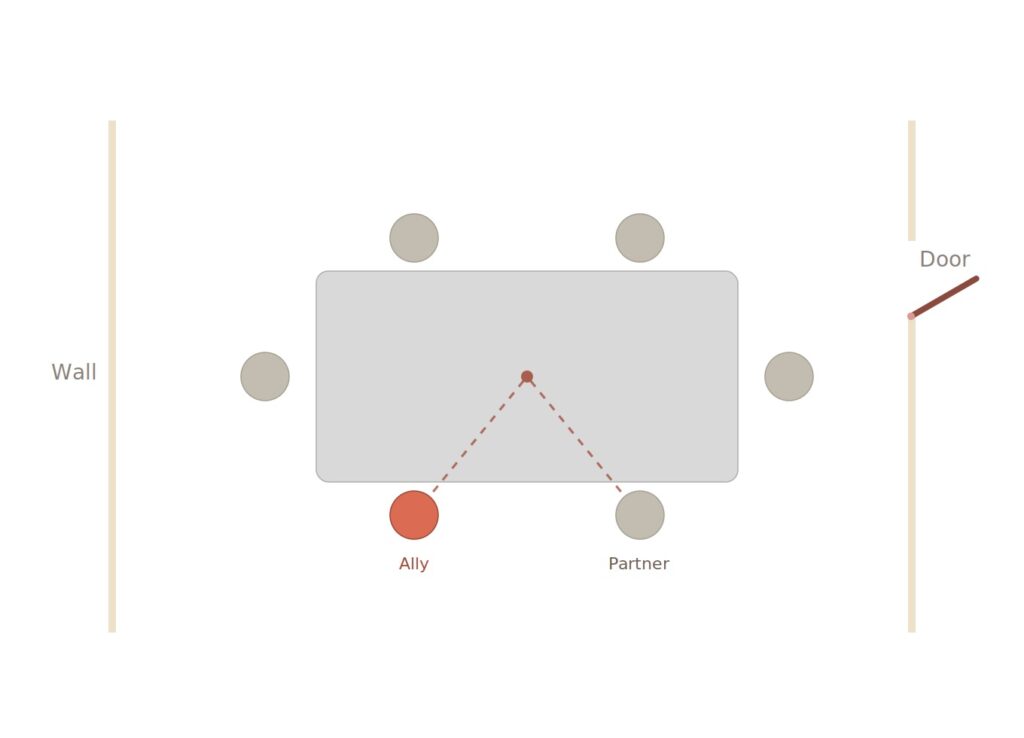
The ally is often not at the table when you first sit down. They are still in the kitchen next to whoever is cooking, handing over the ladle before it gets asked for. At a barbecue, they stand next to their partner, passing the tongs without looking up. With a kid doing homework, they sit beside the kid, not across from them. What an ally wants is the seat next to whoever is doing the work. That is where they can help with it.
Two people sitting shoulder to shoulder look at the same thing, not at each other. That takes the pressure off eye contact and gives them something easy to talk about. When Sommer ran his seating studies, the pairs who were working together almost always picked side-by-side chairs. The pairs who were competing sat across from each other. Sitting beside someone is how you quietly say you are ready to work on something together.
Robert Gifford, an environmental psychologist at the University of Victoria, tested that signal in 1982. He showed people drawings of pairs sitting at different angles, and asked them to rate how close the two looked. Side-by-side scored higher for closeness than face-to-face. The quietest-looking seat in the room is the warmest one.
Allies talk in exchanges built around getting things done, rather than talking them over. So you hear “I’ll grab the milk, you get the bread,” or “I’ll drive there, you drive back.” A lot of that sounds like logistics. But for an ally, the logistics are the love, and people outside the relationship often miss what they are looking at. Their hobbies carry the same shape. That might be a choir, a community garden, or the same soup kitchen every Saturday with the same five people. They do the work beside the same faces week after week. The habit has a cost, though. Some allies go decades without saying the thing that needs saying. There is always another load of washing to fold.
Commanders and challengers might read the ally seat as the quiet option. It is the chair for people who did not want to step up or push back. And strangers watching a couple on the same side of a booth might call them clingy. Both reads miss what is actually happening, because shared work tends to outlast shared opinions. Plans change, and arguments change. But the person who stood next to you through 15 years of school runs and slow Sundays is often still standing there. That feels like a different order of closeness.
The Far End, The Observer
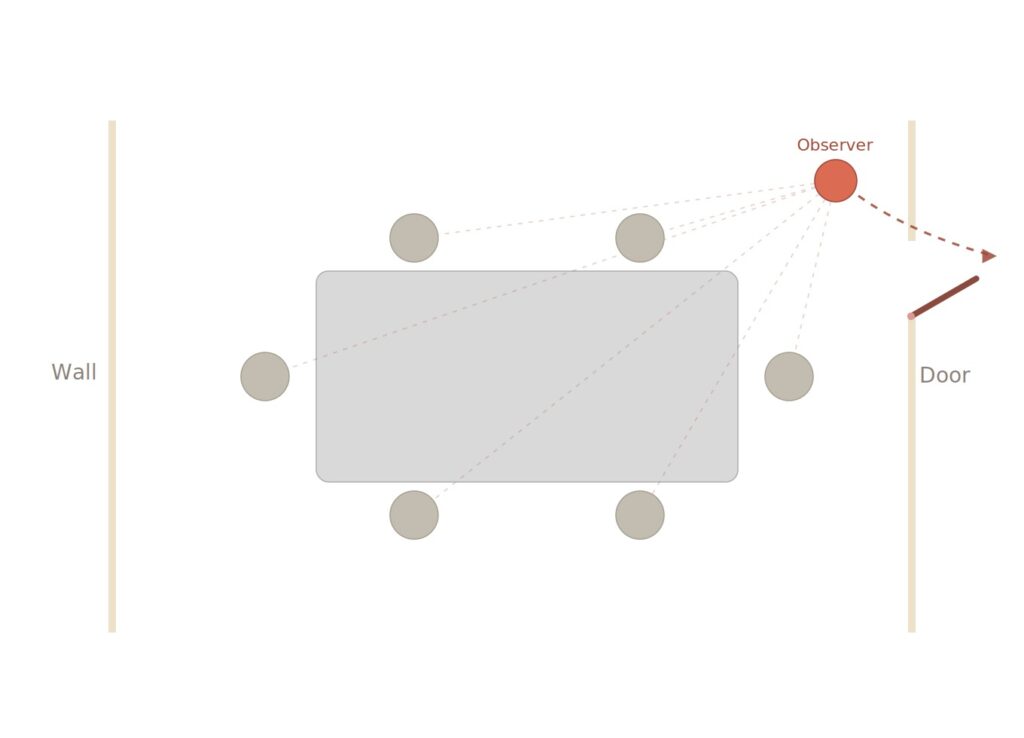
At a family dinner, someone gets up to make tea. They come back with every cup made right, your father’s strong with no sugar since the doctor’s visit. That is the observer, and they are the ones who do not sit where the action is. At a long table, they drift toward the end furthest from the host. In a boardroom, they skip the table and take a chair along the perimeter. They are the quiet person with a notebook who came to listen.
Every other seat runs on small physical signals. These only carry at close range and fade the further you sit from them. Sit far enough from all of it. The table turns into something you watch, rather than something you sit inside. That suits observers, who think in pauses. They tend to say less at the dinner, and often remember more of it than anyone else in the room. So three years later, they might tell you exactly what someone said about their father. They remember how the room went quiet after. They are not gathering this on purpose. It is what happens when you sit slightly outside the action and listen.
At work, observers often write the memo rather than run the meeting. They may be the quiet senior on the team, whose email, when it finally arrives, shifts the direction of the project. Their best thinking tends to happen after the meeting rather than during it. That is maybe why they rarely shine in the moment, and often shine a week later. Their hobbies can tilt toward solo focus. They read alone in a quiet house or run long distances by themselves. They might cook for the people they love, and watch those people eat. The thread running through most of it is attention held for a long time on one thing.
Asked directly, an observer is often the most useful person in the family. Their distance from the action gives them a view no one else has. But here is the question they have to sit with. Is the distance a choice, or is it a habit?
Read More: 6 Types of People Who Are More Likely to Cheat
The Seat Is a Habit, Not a Verdict
If you zoom out, seating is just one small part of a larger pattern. So the next time you have to decide on what seat to sit at a table, you might notice a small pull toward one chair before you sit. That pull might be the same one you felt at tables you sat at as a kid, and for some people, it seems to quietly shape how they end up relating to the people around them, though how much of that is the chair and how much is everything else is hard to say.
The question worth asking is probably not which seat is yours, because by now, you might have a sense of that. The better question is what that seat might be costing you, and whether you still want to keep paying for it. Every seat seems to buy something and sell something else, so people who stay in one chair for years sometimes do not notice the trade until later.
It might be worth trying another chair sometime. Sit somewhere that feels slightly wrong for a night and see what the room looks like from an angle you usually avoid, and see who talks to you when you are not where you normally are. You do not have to become someone else at the table, you just get to find out what a different seat feels like. The seat is probably a habit more than a verdict, and habits tend to move when you move.